I'm not surprised it didn't take readers long to figure out that Robert Galbraith was a pen name for J.K. Rowling because The Cuckoo's Calling is so obviously written from a woman's point of view. Not, as Seinfeld would say, that there's anything wrong with that, but it does make you wonder why Joanne Rowling, or her publishers, are so keen to mask her gender, first with the neutral "J.K." and now with a masculine pseudonym.
But that's not my beef with this book. I loved the Harry Potter books for the language, the wit, the bright turns and twists of plot, the sheer unbridled imagination. I can understand why Rowling would want to use a pen name to write something else without being overshadowed by these crossover children's books, but I don't think mystery thriller is her genre.
I found this book, after an opening with some energy, plodding and tedious. Cormoran Strike (points for finding an unusual name) won neither my sympathy nor my interest one-fourth through a 455-page book. A thriller requires suspense, and there is none here. Mildly quirky characters are puzzling over the apparent suicide of a super-model whose life and death is about as interesting as you would suppose, but after 120 pages there's no threat to anybody. Galbraith/Rowling seems happy to meander through London and its pubs letting the story develop ever so slowly while her hero drinks and smokes and mopes over the break-up with his girlfriend.
Strike is a war amputee with a prosthetic replacing the lower half of one leg. It's an interesting nod to Zeitgeist but somehow in a taut thriller there has to be a reason for this. And then my pet peeve -- the author seems to think we need to know every other page or so that her hero smokes. I'm not a fan of smoking in real life and, absent compelling reasons to the contrary, find the habit in fictional characters off-putting. Generally it seems to me an author is being defensive about what is presumably their own habit. I do put up with it if I like the book otherwise -- as in the Chet and Bernie series (though I'm baffled why that author should be so insistent about it in what is clearly a young adult crossover).
The most interesting character in Cuckoo is Robin Ellacott, a young woman who winds up temping for Strike and displays the pluck of a typical Rowling character. Why Rowling couldn't write under a name like Penelope Galbraith and feature a female protagonist like Robin is the only real mystery I see in this whole undertaking.
I've not had much luck with George Pelecanos in the past, but his work on "The Wire" and other screenplays is so obviously brilliant I gave it another try with an earlier novel, Down by the River Where the Dead Men Go. I'm abandoning it one-fifth of the way through because I'm bored. Bored, I say. The hard-boiled dialogue falls flat and the whole shtick of the detective-bartender-alcoholic just seems dated. It's no wonder that Pelecanos abandoned the first-person narrator Nick Stefanos (get it, a Greek-American) fairly quickly. After the initial set-up -- a mildly interesting binge that results in Nick being sort of passed out by the Anacostia River so that he can sort of witness a murder -- the story gets bogged down with the hero drinking and smoking and moping not just about his girlfriend but about his pitiful situation in general. Enough said.
I also gave up on Swamplandia, again one-fifth through it. This is clearly more serious stuff. Karen Russell's book was a finalist for the Pulitzer Prize (another nail in the coffin of that exercise) and Russell was a recipient of one of the latest genius grants. The writing is fine, but the first-person narrative by the 13-year-old (precocious) daughter of an alligator wrestler doesn't do much for me. The story is supposedly based on Russell's own background, though I find that hard to believe, and the language in any case is too self-knowing and artificial to be convincing. I would be tempted to attribute the success of this book to the chick lit-ization of modern publishing.
I of course reserve the right to return to any of these books in a different mood and find them wonderful. But I don't think so.
Thursday, November 28, 2013

Wednesday, November 27, 2013
Tatiana
My review of Martin Cruz Smith's new Arkady Renko mystery, Tatiana, appeared today in The Washington Independent Review of Books:
Both Martin Cruz Smith and his detective hero Arkady Renko have grown older and wiser and mellower since they burst onto the literary scene with the 1981 thriller Gorky Park. Renko, who started his career as a rebellious militia investigator in the Soviet Union, is now a rueful detective in Vladimir Putin's corrupt and Mafia-ridden Moscow.Renko reflects on this while pursuing his new case. "Whenever Arkady visited the university, he could not help but measure his progress in life against the precocious student he had been. What promise! A golden youth, son of an infamous general, he had floated easily to the top. By now, he should have been a deputy minister or, at the very least, a prosecutor, ruler of his own precinct and feasting at the public trough. Somehow, he had wandered. … Instead of bending, he pushed back, and so guaranteed his descent from early promise to pariah."While the first Renko novel started with the shocking discovery of three corpses in the snow, their faces and fingertips removed to prevent identification, this new case begins with the more sedate demise of a crusading journalist, the Tatiana of the title, who plunges to her death from the balcony of her apartment. Renko's superiors don't even want to consider the case a homicide, but the detective is convinced, after listening to tapes found in her apartment, that Tatiana's murder is linked to an interpreter's notebook she had acquired documenting a mysterious meeting in Kaliningrad.It is the notebook that is the thread tying Tatiana's fate with two other murders — that of the interpreter, whom we see briefly in the arresting prologue, and a gangster we meet as he is being lowered into his grave. Solving the mystery of Tatiana's death, deepened further by the disappearance of her body from the morgue, involves sorting through the mixed motives of an over-the-hill poet of some renown who was her former lover and of Renko's own neighbor and sometime lover, an ambitious journalist herself. Renko's ward, a chess prodigy searching for direction in life, gets into the mix as he tries to decipher the interpreter's symbolic shorthand and find out why this meeting in Kaliningrad has led to so many deaths.The case takes Renko to Kaliningrad and some skullduggery, shootings and chases over dark beaches there. It is in all a satisfying romp through settings rendered exotic by their very remoteness. Smith's prose, always compelling, has become even more deft and incisive over the years. Even his casual observations carry some bite, as when Renko comes across his neighbor Anya together in a bar with the son of the late gangster and joins them for a drink: "They drank, listened to the thunder and poured some more, as if they were old friends gathering before a storm."A younger, brasher Renko might have turned this encounter into a confrontation, but this mellower version politely excuses himself to leave the two alone. He worries about Anya's motives and intentions, but doesn't judge her and lets it go. When his investigations in Kaliningrad offer another opportunity for romance, Renko falls into it without any great expectations, though there are hints this relationship will offer greater fulfillment.All that said, this latest installment in the saga of Arkady Renko, while masterful, is a bit thin. It is relatively short — in spite of the publisher's best efforts to puff it up to nearly 300 pages with a generous font and leading. The descriptions, while often evocative, are sometimes too skimpy. With the exception of the beaches outside Kaliningrad, we actually see little of anything, so that the Russian setting is more of a mood than a place.Kaliningrad, for instance, is a great backdrop for a murder mystery. This geographic anomaly, a Russian exclave squeezed in between Poland and Lithuania, was historically the German Königsberg, a jewel of the Baltic famous as the home of the philosopher Immanuel Kant. It was leveled during the war and rebuilt by Stalin in an unrelenting Communist aesthetic. Smith tells us repeatedly how ugly it is (and it is, I've been there), but once Renko finally reaches the city, the author never really shows it to us. He takes Renko to the Monster — the massive, unfinished party headquarters that stands as a monument to the folly of Stalinism — but it is dark and we don't really see it.Smith, who daringly pioneered this mix of mystery and thriller in dark and foreign landscapes with Gorky Park, has in a way been overtaken by writers following in his footsteps. Alan Furst has perfected the moody and atmospheric tales of moral ambivalence, while Nordic writers such as Jo Nesbø and Arnaldur Indriðason take us now to the frozen north and hidden corpses. The stench of post-Soviet corruption comes through more strongly in books like A.D. Miller'sSnowdrops.In any case, Smith's fans will welcome his latest novel and new readers can find plenty to divert them. To fully appreciate the world sketched in Tatiana, however, those unacquainted with Arkady Renko might want to go first to one of the earlier books in the series, to Gorky Park or Polar Star or any of the other novels in the long and consistent saga of an individual trying to preserve his integrity in an endemically corrupt society.
Thursday, November 14, 2013
Whites

So there is tension, lots of it. Rush's skill as a storyteller brings that tension down to a personal level in his minutely drawn microcosms of the clash between whites and blacks in Botswana. Blacks are always involved, even when the story is about whites. Even "Bruns," the story of a European volunteer who apparently martyrs himself to thwart Afrikaner exploitation of the blacks, is ultimately about the black population, even though the narrator is a white anthropologist telling the story of a white mechanic victimized by white settlers.
"Near Pela" is the claustrophobic tale of two white couples driving through a trench in the bush. The Land Rover is claustrophobic enough, but its confinement in the tracks it must follow makes it even more so. And the vehicle become an emotional hothouse as a woman sympathetic to the plight of blacks caught in a drought and threatened with famine is stonewalled by her husband and gets no support from the other couple.
"Thieving" is an attempt to view white people through the eyes of a native boy. It is the most artificial of the stories as the game attempt to reproduce the language and thought processes of an untutored native fails ultimately to convince. Through a veil, we watch the wife drift completely away from reality, to the point where she has to be institutionalized.
The last three stories all involve Ione, an American woman who relieved the boredom of her life in New Jersey by seducing men and who finds it can help her cope with Africa as well. In "Instruments of Seduction," she seduces yet another fellow expatriate in a fairly desultory manner, because this white man, a doctor, is preoccupied with a hostile encounter he had in an African bar (meaning a bar patronized by Africans rather than just expatriates). In the next story, "Official Americans," Ione plays a supporting role as the mysteriously seductive expatriate who helps an AID worker driven half-crazy by dogs that bark all night to seek relief with a native witch doctor who turns out to be a fake. "Alone in Africa" has Ione finally giving up and fleeing dry, dusty Botswana for more agreeable climes, and hunting grounds, in Italy, leaving her dentist husband alone at home. Frank spends a lonely evening sitting around in a ratty bathrobe drinking wine and is easy prey for a young African woman in the neighborhood to tempt into straying (though Frank claims to be faithful to Ione and is apparently unaware of her hobby).
The moral compass of these whites is spinning hopelessly without any pole to orient them. In our book group discussion, we compared these stories to Paul Theroux's Dark Star Safari and kicked around notions of compassion fatigue and the general difficulty of maintaining empathy in a hopeless situation.
Ultimately, the feeling you get from these stories is that whites don't belong in Africa. Expatriates seem to be largely misfits and they were probably misfits at home, too. On the other hand, Rush seems fatalistic. Whites aren't going to leave, and whites and blacks seem destined to live together in this tension and confusion.
The stories are compelling and finely crafted. The variety of tone and language is stimulating. The unflinching view of an ambivalent environment is daunting, relieved only in part by the mini-catharsis of each story.
Thursday, November 7, 2013
Thereby Hangs a Tail

Chet displays the same wry, deprecating humor that Archie has in narrating Rex Stout's Nero Wolfe mysteries. Like Archie, Chet is slavishly devoted to his brainier colleague. But when it comes to action, it is this narrator who has the upper hand.
Chet drinks only water; Archie drinks only milk. Chet has no life outside his work with Bernie; Archie has very little. Bernie, of course, is more active than Wolfe, but still much of the "leg" work is done by partner Chet.
I've read all of the 70-some Nero Wolfe mysteries and probably would happily read as many Chet and Bernie stories if the author can write that many.
My interest, however, flagged a bit in this third installment, whether from saturation or a drop-off in the quality. The starting point -- acting as bodyguard to a show dog -- was not too exciting. The actual murder mystery developed slowly and haphazardly, with the plot fraying into numerous loose ends that were never satisfactorily tied up.
Nonetheless, it had the elements that make me a fan -- humor, readability, sympathetic characters, Southwest setting (why so coy about telling us whether it's Arizona or New Mexico?).
Two more in the series were on remainder at Politics & Prose so I will try the next one in print. The covers clearly do portray a Border Collie mix, whereas the description of Chet -- from his 100-pound-plus weight to his backstory as a police dog -- mark him as a German Shepherd mix. Only explanation I can think of is the publisher wants a cuter, less threatening dog on the cover.
Sunday, October 13, 2013
Dog On It
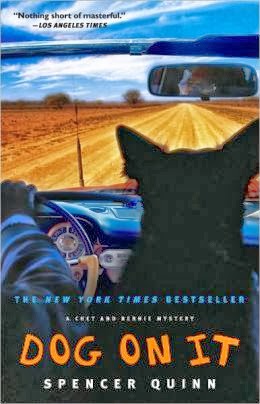
In this book, the first of the series, Bernie and Chet have to find a missing teenage girl whose parents are divorced. The plot has some of the same elements as The Sound and the Furry, with Chet at some point being separated from Bernie and at another point playing a key role in rescuing him.
In both cases of separation, Quinn reminds you how vulnerable dogs are in a human world. It is not really that hard to restrain them and once restrained, they are limited in how they can react. Then, if they do manage to escape and rejoin their human master -- as Chet presumably always succeeds in doing -- they can't tell you anything about it.
The climax in both books comes when Chet gets a chance to spring, literally, into action. This of course, as we know from Rin Tin Tin, is where dogs come into their own. Their speed, their strength, their single-mindedness is what makes them such formidable partners. Teeth help, too.
All that said, I will try to take a break from the series, partly to keep from finishing them off too quickly and partly to keep that endearing freshness. I did read the little squib e-short story, "A Cat Was Involved," which fills in the back story of how Chet and Bernie met. However, it was a half-baked effort to cash in on the series popularity and the story actually worked better when it was suggestive, rather than have all the details filled in.
Thursday, October 10, 2013
God's Crucible

However, it is a dry and essentially academic book so my sessions usually ended with me falling asleep in the chair and I was only able to read "in" it. Some of our book club members were much more thorough. They generally concluded it is indeed interesting to see that period of Europe from the "other" side, but found Lewis a bit too glowing in his descriptions of Islam's contributions and a bit too negative about Europe.
When one of our members read a passage about how Europe might have been happier if Charles Martel had lost at Poitiers, given the years of feudalism that lay ahead in Europe, my question was whether now in the 21st century one would be happier in Europe or Saudi Arabia. In both cases, there has been an organic evolution from the 8th century. Nor was the intervening period in Europe without its accomplishments.
I can't say whether this book explains where Islam went wrong, but no one in the group mentioned any explanations. In discussing how much further advanced the Muslims were in the arts and sciences than Western Europe in this period, I made the point that everyone was more advanced -- the Byzantines, the Alexandrians, and the Persians whose defeat opened up the Middle East for the Islamic jihad. There is no indication that something intrinsic about Islam lends itself to creativity and innovation in the social sciences -- rather the opposite.
The book launched us into a discussion about the influence of religion in general. Why are the major religions that still dominate globally all so old? Does religion really drive events or do political leaders use religion to bind and motivate their followers? We agreed that religion as a touchstone of ethical values and as community were probably as important as belief in the supernatural in perpetuating these old and often reactionary institutions.
Saturday, October 5, 2013
The Sound and the Furry

It's not only Quinn's rendering of the doggy viewpoint, which is something of a tour de force, it is the Carl Hiassen-level humor he employs in narrating his simple mysteries. I use the plural, even though I've only read the one, the latest, because I'm confident the same mastery is maintained throughout the series.
It is of course a sleight of hand to have a dog narrate a story using vocabulary much more sophisticated than what he professes to not understand in the dialogue. But like any good illusionist, Quinn distracts you from this conundrum with his portrayal of Chet living in the moment, losing his thread of "thought," getting distracted by anything remotely resembling food. There is Chet's total lack of self-awareness, so that even as he's narrating the story he becomes aware of his instinctive actions -- barking, growling, snatching a chicken wing, carrying a straw hat away with him -- only when Bernie calls him on it.
Anyone who has spent time with a dog, interacted with a dog, or who just likes animals can't help but appreciate the consistency with which Quinn portrays the simple joie de vivre of the narrator. Whatever depredations the human characters engage in, the reader feels upbeat because Chet feels upbeat.
Bernie Little is not that much different than your typical PI -- flawed, undisciplined, broke -- but seen through the prism of Chet's narration, his heroic side comes to the fore. Not that he's any more heroic than the rest of us, but he is a hero in Chet's eyes, and it's contagious.
The plot itself is not half-bad. You scarcely notice, immersed as you are in Chet's being in the moment, that the plot is moving along, clues are being uncovered, red herrings identified, villains chased down and clients rescued. In this case, Bernie and Chet go to Louisiana bayou country to find a missing person and unravel a mystery involving a ton of stolen shrimp and birds dying of petroleum immersion.
Bernie's choice of vehicle -- a well-used Porsche -- is a plus because it reminds me of my brief ownership of a well-used Porsche. There is little description of Chet in this book -- perhaps there is more detail in the earlier books -- beyond the fact that he weighs 100 pounds-plus. So I have taken to imagining him as a shaggy German shepherd mutt. Once, when he sees Bernie and himself in a mirror, Chet is amazed, saying it looked like Bernie with a tough-looking member of the nation within (Chet's expression for the parallel dog population), realizing only belatedly that it's -- ME.
So I've already downloaded the first book of the series, Dog on It, and will work my way forward. I'm hoping I'll be able to ration them and not just binge-read the whole series.
Spencer Quinn is a pen name for Peter Abrahams, who has written numerous thrillers and young adult books under his own name. Stephen King is a fan and listed four of his novels in his book recommendations in On Writing. So now I've downloaded Lights Out as well.
Subscribe to:
Posts (Atom)