Wednesday, September 29, 2010

The Financial Lives of the Poets


This is not Jess Walter's best book, but it is nonetheless a fun read. Walter's dazzling writing and mordant wit carry the reader along, and if you're willing to look at it as a post-modernist satirical parable rather than a realistic novel, it works.

It falls short, I think, of the high mark set by Citizen Vince and The Zero, but it is entertaining and does make a point. I had a friend in Paris who said when a transport strike resulted in total gridlock throughout the city that he always thought the difference between civilization and barbarism was 10 hours -- and he was almost proven right. Similarly, here, Walter illustrates how thin the veneer of middle-class prosperity is in our society and how quickly a recession can wipe it out.

The premise of the book is blatantly preposterous. The narrator, Matt Prior, gives up his job as a business reporter to launch a Web site that would report financial news in verse. Nobody would ever do that. His subsequent adventures look like a parallel version of Weeds as written by T. Coraghessan Boyle and Elmore Leonard. The sequence of events and the moralistic conclusion are all overdrawn in deliberate satire. What is realistic is the portrayal of the death of newspapers, the hypocrisy of much of middle-class life, the tenuousness of relationships, the tenacity of family, the stupid desperation of criminals -- all portrayed compactly through the eyes of the narrator, who, though flawed, retains our sympathy throughout.

This is probably Walter's funniest book and should make you laugh out loud in parts. Some of the shtick -- the price of milk at 7/11, the demented father patting his pocket for his absent cigarettes -- is overworked, indicating that perhaps the novel needed one more pass by an editor. But the sheer exuberance of the writing makes this a quick and satisfying read.

Much as I like Jess Walter, though, I was glad I'd waited for the paperback version on this one. I'm sure his best book lies in the future.

Thursday, September 23, 2010

Wolf Hall


What a stupendous feat of historical imagination. The bestselling novel by Hilary Mantel brings an astonishing freshness to one of the best-known historical periods and some of its most familiar characters. As it paints its descriptions of Thomas Cromwell and Thomas More in succeeding layers, we get a different look at these key historical figures and the significance of their interplay.

And yet, the reader is never clubbed over the head with any anachronistic hints at the import of what is happening. There are no distracting and superfluous details of life in the 16th century to demonstrate how well researched this book is. It is clearly well-researched, because every detail seems to vibrate with authenticity.

And the language. Clear, precise, and yet so vigorous. Then there's the wit, the charm, the subtleties of a master novelist who invests these characters and this world with a mesmerizing attraction.

Revisionist history is a literary gimmick, of course. We love it for a writer to tell us the other side of the story we think we know. There's John Gardner's Grendel and Gregory Maguire's Wicked -- neither of which I've read -- and Richard Kluger's Sheriff of Nottingham, which I read years ago. We are willing to suspend our disbelief and with a sense of fair play let a writer imagine for us the other side of the story. Beowulf's monster was not so bad, nor the Wicked Witch of the West, and the sheriff of Nottingham was just trying to catch a thief.

The historical Cromwell was most likely the cynical and ruthless manipulator that has been portrayed for us through the centuries. Mantel does not overdo her revisionism and turn him into a saint, but does try to understand how he rose from the bottom of society to become Henry VIII's right-hand man. Could he be the loyal, shrewd, witty paragon with a soft spot in his heart for the underprivileged as portrayed in Wolf Hall? Perhaps, but more likely not. Is he a sympathetic character to carry a reader through this history once again -- absolutely.

Mantel is not so gentle with Thomas More, whom she strips of his sainthood by portraying him as a pathetic, vain fanatic with many unsympathetic attributes, such as the sadistic pleasure he takes in torturing suspected heretics. It's impossible not to cast Paul Scofield in this role and to play this portrait of him as the "bad Superman" from Superman III. It was equally difficult for me not to see Leo McKern, the character actor who played Cromwell in A Man for All Seasons, in the role of the protagonist. The Hans Holbein portrait even encourages this casting.

In the end, they met the same fate, though we have to wait for the sequel to get Mantel's take on Cromwell's fall from power.

The picture of Henry VIII -- that complex, seductive figure who so changed history -- is well drawn, but not different from the one most of us have at this point. Ann Boleyn comes in for particularly harsh treatment, but that, too, is not too much of surprise after other recent books.

The real hook remains Cromwell himself, with his facinating backstory as an abused blacksmith's son, soldier of fortune, merchant banker and unlikely courtier. The slow, natural tipping of Cromwell and England into Protestantism is particularly well drawn. Perhaps one of the most poignant threads of the novel is the martyrdom of John Frith for the Protestant cause, though the pragmatic Cromwell found it just as pointless as More's principled stand on the oath of succession. It will be interesting to see in the sequel what stand, if any, brings Cromwell to the Tower and his execution. Where can I pre-order the book?

Wednesday, September 8, 2010

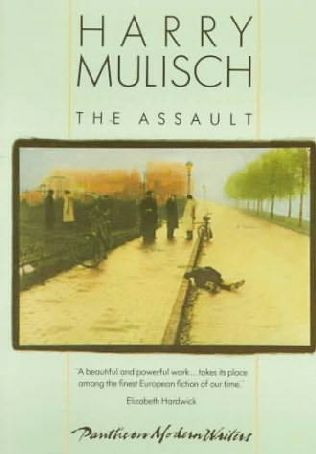
The Assault


Now this is a powerful book. Harry Mulisch's tale of the assassination of a Nazi collaborator in wartime Holland and its effect on a 12-year-old whose family was executed in reprisal plumbs the depths of guilt and integrity in the face of adversity.

The Dutch author deftly sketches the incident and its aftermath in a translation so graceful you'd never guess it wasn't written originally in English. The evocation of sleepy Haarlem, the want and terror of the occupation, the frightening suddenness of the assault, the swiftness of the consequences -- all this sets the stage for the long denoument in the life of Anton Steenwijk.

As in a parable, Anton, who tries to put the horrible events of a single night into a forgotten past, is drawn into encounters that illuminate the full ambivalence of what actually happened -- with neighbors who witnessed his parents' execution, with the son of the collaborator who was assassinated, with the resistance fighter who took part in the assault, and finally with the neighbors who moved the body from in front of their house to Anton's house and unleashed the fury of the Nazis on his family.

He discovers the truth behind the mystery of the woman who provided succor to a traumatized boy on the night of the assault, transforming his life yet again. As the final piece of the puzzle falls into place, he realizes how right he was not to desire or seek revenge for the injustice that befell his family.

There are passages of limpid beauty and breathtaking insight in this compact book. As Anton pursues his medical career in postwar Holland, he feels a detachment from society as a result of this wartime trauma. He votes Social Democratic and then switches his affiliation to a party that claims there is no difference between left and right. "Still, national politics meant little to him: about as much as paper airplanes would mean to the survivor of a plane crash."

But he is not allowed to maintain this detachment. Anton is forced through the author's artifice to face his past in all its ambiguity and to come to terms with it if he is to have any chance at happiness. All of us, of course, though in much less dramatic fashion, face this same challenge.

The White Tiger


This readable and entertaining novel by Aravind Adiga comes with an incredible amount of hype. Its portrayal of an Indian "entrepreneur" who launched his career by murdering his employer (this is not a spoiler, it is revealed early on) is described as "dark and unsettling."

Dark, yes, but as in dark comedy. It may be there is somewhere in India a prosperous entrepreneur who got his start through murder and robbery, just as there certainly were in the U.S., the UK and any other country built on the industry of entrepreneurs. But it would be silly to think that this is the rule and it's not likely that is what Adiga was trying to convey.

It is satire, an Indian Babbitt, in a way, but not, as one blurb would have it, a book as powerful as Native Son or Invisible Man. It won the Man Booker Prize and is written with dazzling wit and surprising grace. The construction of the book as a memo to the Chinese premier is clever, and allows the narrator, Balram Halwai, to declare that the age of the white man is over and the future belongs to the brown and yellow.

It's easy enough to swallow in view of the rapid economic growth in India and China, though personally I think the future of America is more like that of Western Europe and that white people will play a significant role in global affairs for some time to come.

The wonderful characterizations of Balram's family, his employers, his servant milieu carry the reader along on a fascinating journey into the micro-economy behind India's new-found economic success. The withering cynicism of Balram's description of Indian democracy makes the country at first seem uncivilized, though this rampant corruption is not totally unknown in the history of Western society, either.

Balram, the rebellious and murderous servant, is as rare as the white tiger, and as ferocious. His rise as the son of a rickshaw-puller and server in a tea shop to manager of a car service catering to the high-tech startups in Bangalore via a stint in Delhi as driver for the "landlords" of his hometown is an enlightening saga.

In the end, as with Babbitt, the reader is left with an insight into the hollowness of materialism, but also with a debunking of alternative ideals like family, socialism, or democracy. The optimist in me sees it as testimony to the robustness of India's economic awakening. In the normal course of events, India will grow out of the morass of injustice and corruption portrayed in the novel -- as the U.S. continues to evolve from Sinclair Lewis's grim description of early twentieth century life here -- hopefully without violence.

Monday, August 30, 2010

A Summons to Memphis


What a delight to read! This Pulitzer Prize winning novel by Peter Taylor tells a story without any linguistic pyrotechnics or artificial "layering," but with the economy of a writer who made his reputation with short stories.

There are many layers, though, as the narrator, Philip Carver, casts back into the family history that culminates in a crisis when his widower father contemplates marriage to a younger woman and his spinster sisters connive to block it.

It is for the daughters a type of revenge, for their father at a critical point in time intervened to spoil marriages for both of them, as he did for his son. The arc of the novel is how the son, the only one to leave the family's Tennessee home to make a career in New York, comes to terms with his father's decision first to transplant the family from Nashville to Memphis, traumatizing all three children, and second to secretly visit the family of his son's girlfriend in Chattanooga to discourage any marriage.

The answer ultimately is that he does not come to terms with it. He speaks of forgiving and forgetting, but he remains emotionally damaged, living in a comfortable relationship with an equally damaged woman that has the narrowest of parameters and stifles any true happiness.

The daughters, who apparently are even less aware of the permanent damage to their emotional lives, succeed in taking their father captive and preventing his remarriage, safeguarding their inheritance but more importantly securing their revenge. But they have even less satisfaction from it than their brother.

The narrator skillfully portrays the father-worship of his three children, which neither the father's own tragedy of being duped by a close friend nor his selfish interference in the lives of his children can diminish. But the damage is plain to see in that none of his children then ever marry or have children.

So it is a story about fathers and daughters, and about fathers and sons, and the problems resulting from a dominating personality who is also narcissistic. There is something for virtually every reader to relate to. It is not uplifting because the narrator's disillusionment and disappointment end in resignation. By the end of the novel, it is the father -- despite the betrayal by his friend and the successful efforts of his children to block his marriage -- who triumphs. He is indomitable. But he dies and leaves a legacy of pain.

Taylor's lucid prose deftly unfolds the layers of emotion and history in this profoundly dysfunctional family. While the narrator retains the reader's sympathy, it is clear by the end of the book that he is not the best judge of what has happened.

It is a quick read, just over 200 pages. The depictions of Memphis and Nashville are entertaining -- I picked this up from my shelf because of our recent trip through Tennessee -- but they are less important than the universal emotions of the family relationships.

Monday, August 23, 2010

The Dark Vineyard


The charm is still there in Martin Walker's second French country cozy with Bruno, chief of police in a small Dordogne town. Walker wisely avoids a second dip into the dark history of French collaboration with the Nazis and constructs a new plot around very contemporary concerns about ecology, genetically modified crops and industrial production wine.

But the first rule of a murder mystery is to have a murder. The initial crime here is arson, so the suspense is hardly sufficient (not even Bruno seems to really care who set the fire) to help the reader along in the slowly developing plot. Walker's sparkling writing and his vivid descriptions of the quality of life in the Dordogne are sufficient for a Francophile, but the appeal of the series might be limited if it remains too low-key.

In the end a couple of deaths (maybe murder, maybe not) and the brutal killing of an aged dog add a little juice to the narrative.

One of the highlights is the meal Bruno prepares for some friends, featuring a game bird shot by Bruno, which Walker stubbornly and oddly refuses to translate (Wikipedia tells me becasse is woodcock). It's hard to imagine that English and American women would follow the example of the French men and actually slurp down the stomach and crunch the bird's skull as part of the meal, no matter how enamored they may be with lovable old Bruno, but it does give a sense of France's gustatory zeal.

The resolution is all a bit anti-climactic, perhaps because there's very little true villainy. The French characters are all just a bit too nice in the end -- Walker, unlike Peter Mayle, seems unwilling to offend his friends back in the Dordogne. But if you liked the first book, this one goes down easy, too.

Monday, August 16, 2010

Spies of the Balkans


Alan Furst is back creating another morally ambivalent, atmospheric thriller featuring a hard-bitten foreign protagonist. This time it is the Greek Costa Zannis, who is remarkably similar in his attitudes and cigarette smoking to the French, Hungarian and Dutch protagonists of Furst's earlier novels.

We listened to this on audiobooks during a road trip and it was entertaining enough, though Furst has clearly fallen into purely formula writing. Watch a few old movies (he even refers to one character as a real cinematic aviator), research a relatively obscure location (Salonika, Greece in this instance), insert above-mentioned hard-bitten protagonist, add a few lady friends, and wrap everything in a smoky nostalgia that makes it as blurry and comforting as the black-and-white movie you started with.

I happen to like a lot of this, particularly the obscure locations. Furst plays this one to the hilt, with Zannis shuttling off to Belgrade and Budapest, with a quick dash to Paris, and dispatching loved ones to Istanbul and Alexandria, while carrying on three love affairs in Salonika. Some of the romantic scenes were amazingly clumsy, bordering on the adolescent. And in an audiobook you don't have the freedom to skim over the embarrassing parts.

The reading by Daniel Gerroll was easy to listen to and follow. His comfortable pace was well-matched to Furst's unhurried narrative style and he was consistent in his characterization of Zannis and other main figures, so there was virtually no confusion in a book populated by people with names that are strange to our ears. No small feat.

Furst belabors the history a bit more in this book than he has in some earlier works, probably because this location and the action he describes (Greece girding for the Nazi assault) is so obscure to American readers. He is at his best describing the fin du monde atmosphere of a country coming under siege and the desperation that accompanies it. The story of an underground railroad smuggling Jews out of Germany to freedom, in Turkey of all places, was moving and rich in historical context.

Less successful was Furst's attempt to show a Gestapo officer at work, which seemed to owe too much to Hans Fallada's Every Man Dies Alone to be called original.

We bought the audiobook at Books a Million in Tennessee because we inadvertently left behind the audiobooks we had bought for the trip in our hotel the first night. Out of the dozens of audiobooks on sale, it was the only one we felt both of us could enjoy and that proved to be the case.