Sunday, October 31, 2010

The Redbreast


Jo Nesbo tries and largely succeeds in blurring the lines between crime fiction and literary fiction. There is murder and police and something like a procedural in The Redbreast, but this Norwegian writer is plumbing the depths of individual psyche and also political consciousness.

Most good crime fiction tries to do this, but some succeeds more than others. In a posting last year on Nordic crime fiction, I reported that I had gotten bogged down in Redbreast because the hero, Harry Hole, disappeared from the early pages as the author developed a back story set in 1944 on the Eastern Front.

So I started over in a more receptive frame of mind and let the back story play at its own rhythm. It is of course vital for understanding the action set in contemporary Oslo. It is something of a challenge to an English reader because the unusual Norwegian names, while not as bad as Russian, are difficult to hold onto. It is further complicated by the fact that characters have similar names, names similar to their birthplaces, nicknames, identity switches and, one begins to suspect, multiple personality disorders.

Nesbo lays out his plot in a leisurely but well-paced manner. Harry remains largely sympathetic, though he does rub you the wrong way sometimes. There are more murders, including a nasty philanderer who messed with the wrong woman at the wrong time and one victim whose murder is still left partly unsolved at the end of the novel -- a thread to be continued no doubt in the next installment in the series.

These Nordic crime novels do convey the curious charm of Scandinavia, these northern countries that are a fascinating blend of European culture and frontier ruggedness. Can spring feel so good without the rigors of a dark, cold winter? Oslo and Norway, more so than Stockholm and Sweden, carry those echoes of Vikings and Atlantic harshness.

Like Stieg Larsson in his Dragon Tattoo series set in Sweden, Nesbo is fascinated by Norway's Nazi past and neo-Nazi present. Dark undercurrents of fascism run through Norwegian society then, during the war, and now. Even Americans who know what Quisling means are probably unaware that he was a Norwegian official who headed the collaborationist government during the Nazi occupation of Norway. The Norwegian resistance, in Nesbo's portrayal, was a feeble movement that gained mythic proportions only after the Nazi defeat.

All of this creates a rich environment of conspiracy and political betrayal that lends impetus to the narrative in Redbreast. A full cast of well-drawn characters, not one but two love stories, a villain who is evil but still arouses a touch of sympathy, some nail-biting suspense, murder and gore -- it's all here in a well-written and well-translated 521-page package.

Having sampled and enjoyed detective stories from in Sweden, Norway and Iceland, I suppose I should look for some Danish and Finnish detectives. I'm betting publishers have looked for and found equally talented authors in these countries to produce crime fiction that by now, given how trendy Nordic is, has found its way into English. Watch this space.

Thursday, October 21, 2010

The Vagrants


I ordered this book the day I read that Yiyun Li had won a McArthur Foundation genius grant and found myself immersed in a mind-bending trip back to the Cultural Revolution in China in the late 1970s.

Given the place of China in the world today, it is an amazing glimpse into a corrupt and regimented world, a 1984 for the Asian brand of totalitarian rule. It depicts the deracination of culture where people are firmly rooted in tradition and even superstition. The only people truly at home in this world are the rootless vagrants, Old Hua and his wife, who return to their wandering ways after the unfortunate events in Muddy River narrated in the novel.

It is an ensemble cast of characters, though the main narrative thread is the relationship between Nini, a young handicapped woman, and Bashi, a dangerously amoral outsider. It is framed by the executions of two idealistic young women who automatically become counterrevolutionaries when they become disillusioned with Mao's revolution.

These are small characters in a small provincial town and yet they embody the epic sweep of the Cultural Revolution, a hypocritical leap forward that marked the end of any socialist pretenses in China. It shows simple people who have been deprived of their moral compass through the oppression of the Communist regime -- whether the cynical depravity of Old Kwen, entrusted to bury the executed Shan Gu, or the innocent treachery of Tong, a six-year-old whose biggest concern is the disappearance of his dog Ear.

Shan Gu, a model revolutionary during her teens, has her execution for counterrevolutionary activities brought forward so that her kidneys can be harvested for a well-connected official in the provincial capital. It would be hard to find a more horrifying metaphor for the exploitation of a helpless populace by a corrupt regime. Shan Gu's subsequent further posthumous mutilation before her burial completes the picture of moral bankruptcy.

By an odd coincidence, The Vagrants is the second book in a row for me featuring a deformed and crippled young woman in a prominent role. Like Mikkelina in Arnaldur Indridason's Silence of the Grave, Nini lacks the looks and charms of a nubile young woman, but that does not stop her womanly yearnings. But if women in general are helpless and vulnerable in the two societies portrayed in these novels, this is especially true of a crippled woman. In both cases, they are the survivors, however, and a testimony to human resiliency. The portayal of Nini's modest longings is almost unbearably poignant at times and makes her in some ways the true heroine of this story.

Yiyun Li's other published work is a collection of short stories, and the interweaving strands in this novel owe much to her skill in depicting these small self-contained narratives. We come to know Teacher Gu and his wife, Tong and his drunken father and long-suffering mother, the odd Bashi and the sympathetic Nini, the news announcer Kai and her husband Han and platonic lover Jialin. The trajectory set in motion by the execution of Shan Gu is clear in advance and yet told with exquisite care. The naive and foolish hopes of the young and the vain efforts of the mature to remain indifferent all become enmeshed in an oppressive and stifling environment without honor or justice.

Oddly enough, the least visible characters in the novel are the vagrants of the title, the Huas. The childless couple moved around restlessly, taking care of unwanted infant girls, until they settled for a time in Muddy River. It turns out to be a brief respite before they feel compelled to resume their vagrant life.

The novel depicts a life of simplicity and extreme poverty that nonetheless has its own dignity to the extent it can escape the ravages of regime. A hungry Nini scrapes the flour paste off of posters for nourishment and Teacher Gu squirrels away a precious Parker pen for decades.

It is a heartbreaking work and so relevant for our times. Material conditions have improved in China but the fundamental injustice, and presumably corruption, of the system remain intact. The recognition for Li's fiction, as well as the Nobel Peace Prize for imprisoned activist Liu Xiaobo keep us from forgetting that fact.

Sunday, October 3, 2010

Silence of the Grave


Channel surfing one evening I came upon the Icelandic film Jar City and was intrigued by the stark landscape and Nordic chill of what I learned was a film based on a novel by Arnaldur Indridason. This book continues the series.

As is the case with Wallander and other Nordic detectives, Indridason's Inspector Erlendur is a flawed, unhappy man who has a knack for solving crimes. The environment is bleak and intense, and in Iceland, there is a frontier element missing in the more prosperous Sweden, Denmark and Norway. It helped to have seen that landscape in Jar City -- hard to imagine how the American remake that is in production can match the Icelandic original.

What makes Silence of the Grave compelling as a novel, however, is not just atmosphere, but the deep-running psychology of a 60-year-old incident -- I hesitate to say crime -- that Erlendur tracks down when a skeleton is discovered on the outskirts of Reykjavik during construction of a new housing development. The portrayal of a wife-beating brute and the effect of his abuse on his family is intense and hard-hitting. The suspense is maintained by the painfully slow unearthing of the skeleton by an archeological team. After all, what hurry is there getting to the bottom of a death that clearly occurred decades ago.

I have the feeling it is not a great translation, but it's hard to know if a certain stylistic clumsiness is in the original or is due to the translator. The characters and atmosphere, the boldness of the plotting, more than compensate in any case, so the book is decidedly gritty.

The parallel development of Erlendur's character, his relationship with his daughter, the troubling secrets of his own past add another layer of psychological texture that makes the book very satisfying to read. Indridason takes a page out of Henning Mankell's book to make Erlendur's assistants mildly interesting in their own rights.

So Iceland is well represented in the new wave of Nordic crime writers. The harsh environment of these countries touching the Arctic Circle is anything but cozy, and strips society and the characters of the novel down to the essentials. It helps that the writers are not without talent and that we are now getting access to them in serviceable translations.

Wednesday, September 29, 2010

The Financial Lives of the Poets


This is not Jess Walter's best book, but it is nonetheless a fun read. Walter's dazzling writing and mordant wit carry the reader along, and if you're willing to look at it as a post-modernist satirical parable rather than a realistic novel, it works.

It falls short, I think, of the high mark set by Citizen Vince and The Zero, but it is entertaining and does make a point. I had a friend in Paris who said when a transport strike resulted in total gridlock throughout the city that he always thought the difference between civilization and barbarism was 10 hours -- and he was almost proven right. Similarly, here, Walter illustrates how thin the veneer of middle-class prosperity is in our society and how quickly a recession can wipe it out.

The premise of the book is blatantly preposterous. The narrator, Matt Prior, gives up his job as a business reporter to launch a Web site that would report financial news in verse. Nobody would ever do that. His subsequent adventures look like a parallel version of Weeds as written by T. Coraghessan Boyle and Elmore Leonard. The sequence of events and the moralistic conclusion are all overdrawn in deliberate satire. What is realistic is the portrayal of the death of newspapers, the hypocrisy of much of middle-class life, the tenuousness of relationships, the tenacity of family, the stupid desperation of criminals -- all portrayed compactly through the eyes of the narrator, who, though flawed, retains our sympathy throughout.

This is probably Walter's funniest book and should make you laugh out loud in parts. Some of the shtick -- the price of milk at 7/11, the demented father patting his pocket for his absent cigarettes -- is overworked, indicating that perhaps the novel needed one more pass by an editor. But the sheer exuberance of the writing makes this a quick and satisfying read.

Much as I like Jess Walter, though, I was glad I'd waited for the paperback version on this one. I'm sure his best book lies in the future.

Thursday, September 23, 2010

Wolf Hall


What a stupendous feat of historical imagination. The bestselling novel by Hilary Mantel brings an astonishing freshness to one of the best-known historical periods and some of its most familiar characters. As it paints its descriptions of Thomas Cromwell and Thomas More in succeeding layers, we get a different look at these key historical figures and the significance of their interplay.

And yet, the reader is never clubbed over the head with any anachronistic hints at the import of what is happening. There are no distracting and superfluous details of life in the 16th century to demonstrate how well researched this book is. It is clearly well-researched, because every detail seems to vibrate with authenticity.

And the language. Clear, precise, and yet so vigorous. Then there's the wit, the charm, the subtleties of a master novelist who invests these characters and this world with a mesmerizing attraction.

Revisionist history is a literary gimmick, of course. We love it for a writer to tell us the other side of the story we think we know. There's John Gardner's Grendel and Gregory Maguire's Wicked -- neither of which I've read -- and Richard Kluger's Sheriff of Nottingham, which I read years ago. We are willing to suspend our disbelief and with a sense of fair play let a writer imagine for us the other side of the story. Beowulf's monster was not so bad, nor the Wicked Witch of the West, and the sheriff of Nottingham was just trying to catch a thief.

The historical Cromwell was most likely the cynical and ruthless manipulator that has been portrayed for us through the centuries. Mantel does not overdo her revisionism and turn him into a saint, but does try to understand how he rose from the bottom of society to become Henry VIII's right-hand man. Could he be the loyal, shrewd, witty paragon with a soft spot in his heart for the underprivileged as portrayed in Wolf Hall? Perhaps, but more likely not. Is he a sympathetic character to carry a reader through this history once again -- absolutely.

Mantel is not so gentle with Thomas More, whom she strips of his sainthood by portraying him as a pathetic, vain fanatic with many unsympathetic attributes, such as the sadistic pleasure he takes in torturing suspected heretics. It's impossible not to cast Paul Scofield in this role and to play this portrait of him as the "bad Superman" from Superman III. It was equally difficult for me not to see Leo McKern, the character actor who played Cromwell in A Man for All Seasons, in the role of the protagonist. The Hans Holbein portrait even encourages this casting.

In the end, they met the same fate, though we have to wait for the sequel to get Mantel's take on Cromwell's fall from power.

The picture of Henry VIII -- that complex, seductive figure who so changed history -- is well drawn, but not different from the one most of us have at this point. Ann Boleyn comes in for particularly harsh treatment, but that, too, is not too much of surprise after other recent books.

The real hook remains Cromwell himself, with his facinating backstory as an abused blacksmith's son, soldier of fortune, merchant banker and unlikely courtier. The slow, natural tipping of Cromwell and England into Protestantism is particularly well drawn. Perhaps one of the most poignant threads of the novel is the martyrdom of John Frith for the Protestant cause, though the pragmatic Cromwell found it just as pointless as More's principled stand on the oath of succession. It will be interesting to see in the sequel what stand, if any, brings Cromwell to the Tower and his execution. Where can I pre-order the book?

Wednesday, September 8, 2010

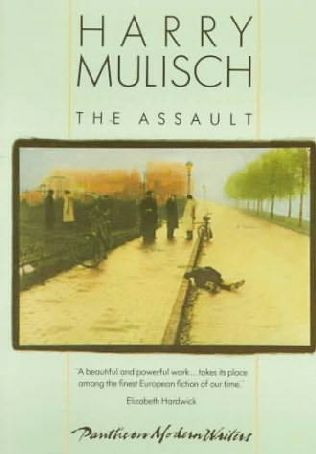
The Assault


Now this is a powerful book. Harry Mulisch's tale of the assassination of a Nazi collaborator in wartime Holland and its effect on a 12-year-old whose family was executed in reprisal plumbs the depths of guilt and integrity in the face of adversity.

The Dutch author deftly sketches the incident and its aftermath in a translation so graceful you'd never guess it wasn't written originally in English. The evocation of sleepy Haarlem, the want and terror of the occupation, the frightening suddenness of the assault, the swiftness of the consequences -- all this sets the stage for the long denoument in the life of Anton Steenwijk.

As in a parable, Anton, who tries to put the horrible events of a single night into a forgotten past, is drawn into encounters that illuminate the full ambivalence of what actually happened -- with neighbors who witnessed his parents' execution, with the son of the collaborator who was assassinated, with the resistance fighter who took part in the assault, and finally with the neighbors who moved the body from in front of their house to Anton's house and unleashed the fury of the Nazis on his family.

He discovers the truth behind the mystery of the woman who provided succor to a traumatized boy on the night of the assault, transforming his life yet again. As the final piece of the puzzle falls into place, he realizes how right he was not to desire or seek revenge for the injustice that befell his family.

There are passages of limpid beauty and breathtaking insight in this compact book. As Anton pursues his medical career in postwar Holland, he feels a detachment from society as a result of this wartime trauma. He votes Social Democratic and then switches his affiliation to a party that claims there is no difference between left and right. "Still, national politics meant little to him: about as much as paper airplanes would mean to the survivor of a plane crash."

But he is not allowed to maintain this detachment. Anton is forced through the author's artifice to face his past in all its ambiguity and to come to terms with it if he is to have any chance at happiness. All of us, of course, though in much less dramatic fashion, face this same challenge.

The White Tiger


This readable and entertaining novel by Aravind Adiga comes with an incredible amount of hype. Its portrayal of an Indian "entrepreneur" who launched his career by murdering his employer (this is not a spoiler, it is revealed early on) is described as "dark and unsettling."

Dark, yes, but as in dark comedy. It may be there is somewhere in India a prosperous entrepreneur who got his start through murder and robbery, just as there certainly were in the U.S., the UK and any other country built on the industry of entrepreneurs. But it would be silly to think that this is the rule and it's not likely that is what Adiga was trying to convey.

It is satire, an Indian Babbitt, in a way, but not, as one blurb would have it, a book as powerful as Native Son or Invisible Man. It won the Man Booker Prize and is written with dazzling wit and surprising grace. The construction of the book as a memo to the Chinese premier is clever, and allows the narrator, Balram Halwai, to declare that the age of the white man is over and the future belongs to the brown and yellow.

It's easy enough to swallow in view of the rapid economic growth in India and China, though personally I think the future of America is more like that of Western Europe and that white people will play a significant role in global affairs for some time to come.

The wonderful characterizations of Balram's family, his employers, his servant milieu carry the reader along on a fascinating journey into the micro-economy behind India's new-found economic success. The withering cynicism of Balram's description of Indian democracy makes the country at first seem uncivilized, though this rampant corruption is not totally unknown in the history of Western society, either.

Balram, the rebellious and murderous servant, is as rare as the white tiger, and as ferocious. His rise as the son of a rickshaw-puller and server in a tea shop to manager of a car service catering to the high-tech startups in Bangalore via a stint in Delhi as driver for the "landlords" of his hometown is an enlightening saga.

In the end, as with Babbitt, the reader is left with an insight into the hollowness of materialism, but also with a debunking of alternative ideals like family, socialism, or democracy. The optimist in me sees it as testimony to the robustness of India's economic awakening. In the normal course of events, India will grow out of the morass of injustice and corruption portrayed in the novel -- as the U.S. continues to evolve from Sinclair Lewis's grim description of early twentieth century life here -- hopefully without violence.