Showing posts with label novels. Show all posts

Sunday, September 4, 2011

The Gospel of Judas


I came back to this Simon Mawer novel now because I liked The Glass Room so much and because it seemed like a good segue from The Essene Conspiracy. Aside from the quantum leap in quality of the writing, this is a completely different kind of book. While it has a papyrus from a Qmran type source that offers a radically different version of Christ's life and the founding of the church, like Wachtel's book, like Da Vinci Code and its numerous imitators, this is not a thriller.

It is a novel about a priest's loss of faith, a complex drama in which the discovery of a putative "Gospel of Judas" plays a decidedly minor role and only really in the last third of the book. The story of Father Leo Newman, a British papyrologist who lives in Rome, has as much in common with Bernanos' Diary of a Country Priest and J.F. Powers' Morte d'Urban as it does with the garden variety biblical thriller.

Mawer in fact has such an understanding of the celibate's mind, the emotional stunting that accompanies the vow of chastity, the fragile foundation in faith for this type of dedication, that I checked his biography to see if he actually was in the seminary. If he was, his bio gives no indication of it, so perhaps he has simply gotten to know a number of priests well in his 30 years of living in Rome. In any case, I know from my own experience as a Jesuit novice and seminarian that he describes those feelings with agonizing accuracy.

Less surprising is how Mawer can make Rome palpable with a few deft strokes. These are not elaborate descriptions but telling details that betray an intimacy with the sights, sounds and smells of the Eternal City. I've only spent a smattering of weeks in Rome, but the city came rushing back into my memory in Mawer's narrative.

There is more to say about the plot but it is again the language that for me is in the forefront. It is a muscular prose, as vivid in its description of the tangible as the intangible. It is a sophisticated, sinuous narrative that has room for Latin, Italian, Greek, German seamlessly embedded in the text. In my research about the author, I came across this statement from an interview he gave:

"To write decent novels you have to be in love with the language. You have to feel the texture of it between your fingers, mould it like clay, carve it like marble. Despite all the creative writing programs in the world, I am sure this ability cannot be taught. So I try to use the meanings of words, of place names, of personal names, to inform the narrative."

This is exactly what comes across. In this book, just for instance, Mawer uses the redolent names of Rome's churches to convey the grandeur, the historicity, the plasticity, even, of these monuments -- Santa Maria Maggiore, San Crisogono, Santa Maria dell'Anima, San Lorenzo fuori le mura. His descriptions of the picnics and outings that his mother, the wife of the German ambassador to Italy, made in wartime Rome evoke the splendid ruin of Italy's past. Such pursuit of civilized leisure even as the Axis war machine rains terror on the rest of Europe is reminiscent of Visconti's "The Damned."

Mawer the writer does not seem to have much use for fidelity in marriage. Perhaps there's too little drama in that and it's only the adulterous affair that merits a novel. Leo's mother, the wife of the German ambassador, and Leo's lover, the wife of the British ambassador (no subalterns here) conduct curiously parallel affairs in Rome. Their husbands are similarly cold and detached, the implication being that this is the type of personality that becomes a successful diplomat. The women characters are so much more vibrant, despite their frailty or instability or moral flaws.

Judas Iscariot, the apostle, is the author of the gospel that Leo comes to believe is genuine. But the novel is full of other Judases. Leo's mother betrays her lover in a way that can know no forgiveness (except from the betrayed), and Leo himself earns the title of Judas for turning his back on his priesthood and the 2,000-year history of Christianity.

The details of the gospel are interesting, how it transforms the narrative of Jesus' life simply by shifting a couple of small facts. Whether genuine or forgery, whether a truthful account or deliberate misinformation, the gospel of Judas has little chance of challenging the centuries-old Christian faith. History has too much invested in the received tradition to accept any other truth, even if factual. Yes, the gospel has information that could shake Christianity to its foundations, but it can never earn the credence that would allow this to happen.

Just where the author stands in all this become clear in his account of Leo's "pilgrimage" at the end of the book, which explains why the church will remain triumphant and why it's futile to seek the truth.

Faith has no object to begin with, so it cannot be exposed. As Leo's lover Madeleine tells him when he finally accepts the inevitable about their relationship: "Poor poor Leo, learning at last the only lesson life has to give." "What's that?" [Leo asks]. "That there is nothing else. that there is only you and me, now, at this moment and this place. All else is no more than empty hope."

Just a few pages later, when Madeleine asks Leo if he still believes after the discovery of the gospel, Leo tries to say that belief doesn't just "evaporate."

Madeleine responds: "Doesn't it? That's exactly what it seems to do in my experience. Evaporate, like a lake or something drying up, leaving nothing behind but mudflats and a few dirty puddles and a musty smell of superstition."

Mawer clearly doesn't set out to write bestsellers. This is anything but a potboiler, though it is a compelling read and has its own suspense. Nor will his willingness to mock Christianity and make an apostate priest his hero endear him to legions of believers. But the reader doesn't have to identify with Leo. The reader can see him as a flawed, in some ways tragic individual. The Gospel of Judas is a question, not an answer, and the reader can decide where the truth lies.

Friday, June 3, 2011

The Thousand Autumns of Jacob de Zoet

David Mitchell continues his mesmerizing way with prose, telling a long tale that works on so many levels. I thought that unlike Cloud Atlas this might be a more classic, continuous narrative and it was, in a sense. But Mitchell once again glided from one world to a different one, shifting mood and voice as he portrayed first the claustrophobic Dutch trading post of Dejima, with all its characters and the main protagonist, Jacob de Zoet, and then shifted to two successive scenes on mainland Japan, and finally told the story from the point of view of an intruding British frigate and its gouty captain.

This is show, don't tell at its best, with a virtuosic command of dialogue and detail. The two main characters, Jacob and Orito, are finely nuanced and immensely sympathetic. The other characters offer a rich tapestry of late 18th century rogues, with the physician, Marinus, playing a deliciously enigmatic role. If anything, the villains -- the abbot Enomoto and the deputy chief Peter Fischer -- lapse into a one-dimensionality that fail to convince. When Enomoto's voice chills Jacob's spine, the reader does not feel that with him because the abbot's character is not sufficiently drawn to feel the threat.

But the overwhelming sense of repression and claustrophobia that characterized both Dutch and Japanese societies in this epoch is wonderfully captured in this story of a small island, cut off from the mainland by fierce cultural resistance and from its European roots by a wide, wide ocean. Jacob and Orito's heroic struggles to maintain their integrity amid truly incredible levels of corruption drive the story, along with their unlikely romance. (to be updated)

Tuesday, April 26, 2011

Forgetfulness


Ward Just is always hard to classify and this novel is no exception. Here's what we know: Just is a fine craftsman -- his writing is lucid, not lyrical but able to conjure up a scene, a feeling, an atmosphere. He spent considerable time in France as an expatriate, I'm guessing, because his books with that kind of setting are filled with an authenticity and level of detail you can't get any other way. But he doesn't feel obliged to stick to any one kind of setting or even genre.

Just is part of the dying breed of solid mid-list authors. He doesn't write glitzy bestsellers. His plots are tame and his writing abjures pyrotechnics. He is decidedly quirky. In this book, for instance, he forgoes quotation marks so that dialog appears largely as indirect discourse. This is all very French, but not something we expect from an American author.

The protagonist here, Thomas Railles, is a portrait painter, pretty much retired in southwestern France, who at one time dabbled in odd jobs for the CIA because two of his hometown buddies worked for the agency. The story begins with Thomas's French wife, Florette, twisting her ankle during a walk by herself in the nearby Pyrenees. She is unable to walk and it is getting cold and dark. A band of foreigners -- smugglers? -- picks her up and carries her some distance before abandoning the effort. She is found dead the next day, her throat slit.

It emerges that the four men may have been Islamic terrorists. Thomas's buddies, who were visiting him and distracting him when Florette embarked on her lonely walk, speculate it might have something to do with Thomas's CIA past. Just never resolves these ambiguities for the reader. When, in somewhat contrived fashion, the band is later tracked down by French security forces, the leader, Yussef, said she was a silly woman who recklessly walked by herself and who had died of the cold before he half-heartedly attempted to slit her throat as an act of mercy. The doctor in Thomas's village said Florette might have survived hypothermia if she had been found just an hour earlier, implicitly blaming Thomas for her death because he was busy regaling his friends with stories well after he should have expected Florette to return and was late in embarking on a search for him.

There are flaws with this plot. Why would these men even waste any time carrying Florette down the mountain if they truly were terrorists? If they did bring her closer to rescue, why did it take so long to find her?

But Just's focus is more on Thomas, what he has made of his life as a painter. It's about his regrets, some things he's forgotten, but far worse, some things he can't forget. One clandestine assignment involved betrayal of a Spanish communist that resulted in his death, and Thomas felt guilty being involved in the assassination of a man he painted and considered to be essentially a good man.

The question Just seems to be driving at is how can we blame anyone or seek revenge for the seeming randomness of death. In a post-9/11 world, he seems to be saying, Americans may be engaged in a futile attempt to fight a ghostly Islamic enemy that is not really the principal threat in our lives. In all likelihood, Florette would have died of exposure on the mountain without any intervention from the terrorist band, because she was, as Yussef suggested, careless in walking on treacherous terrain by herself and Thomas was, as the doctor suggests, negligent in starting up a search for her.

Thomas is not really very sympathetic. He waves off any guilt in Florette's death much as he has waved off any real responsibility for any of his actions. Another friend of his, St. John Granger, had died of old age in the previous week. Granger improbably was a British deserter from World War I, presumed dead with his name engraved on a monument in northern France. His hidden life in a forgotten corner of France is a metaphor for Thomas's own cryptic existence.

Just's achievement is to open up these wide vistas through a relatively compact story. At the end, Thomas has a Fellini-esque meeting with one of his old hometown buddies, presumably his last, and is left sitting literally in a fog, with his best hope that he will forget things.

It was easy for me after my years in France to relate to Thomas's existence in Roussillon. I had a friend in Paris whose parents lived down there and so I visited a couple of times. Just's descriptions are tellingly accurate down to the smallest detail and he is clearly a francophile, even when he portrays common French faults.

The only other book of Just's I can remember reading is his 1991 novel The Translator, also set in France, though it seems to me I've read at least one other (obviously I have no trouble forgetting). I bought this one on remainder. I'll see how long it stays with me to decide on future books.

Thursday, February 24, 2011

Homecoming


Bernhard Schlink's compelling novel works on many levels.

It is a love story, where the narrator, Peter Debauer, and his love, Barbara, look for happiness in the routine of cohabitation and find it hard to maintain.

It is a philosophical novel, exploring ideas on governance in society and debating concepts like "the Odyssey of law" and deconstructionist theory.

Above all, it is a novel, like Schlink's The Reader (which I haven't read but know only from the movie that won Kate Winslet her Oscar), that delves into the long-lasting impact of the war on German society. The catastrophic disruption of World War II has an aftermath of displacement and deception that lasts till today.

This is what has the most appeal to me because, I confess, I do get homesick for Germany from time to time. Tell-tale details about daily life in Germany are sweetly nostalgic for me. And there is Schlink's decidedly German point of view, so that even reading this in English I can almost hear the narrator speaking in German.

There is deception at every level and in every character. The main action of the novel -- Peter's search for his elusive father, long thought (by him) to be dead -- describes the series of deceptions practiced by this man. Peter's mother deceived her son into thinking she was married to his father and he was dead, neither of which was true. His grandparents, we realize in retrospect, played along with this charade. But Peter himself engages in a series of deceptions as he tells himself he is looking for the truth.

Much of this deception has its roots in war crimes, as with the Kate Winslet character in The Reader. Peter's father, it emerges, was at least closely associated with a bona fide war criminal, even if there was no evidence of his own crimes. The crimes of war led to the criminal division of Germany, which created its own set of deceptions. The story is set during the time that the Berlin Wall collapses and Peter inserts himself into the parallel universe that is East Germany, posing as a legal scholar to teach classes in Berlin.

Eventually, Peter's search for his father takes him to New York, where his father has reinvented himself as a professor at Columbia (Schlink coyly does not mention the name of the university, but it is clearly Columbia, right down to meeting in front of the International Affairs building, my home for two years). Peter pretends to be a visiting scholar so he can audit his father's seminar. While America does not share the wartime roots of deception that Germany has, it proves to be a place where deception is not only tolerated, but welcomed.

The novel proceeds in a succession of almost novella-like segments, each one with its own setting and mood that often have little to do with each other. There is the idyllic opening segment of Peter's childhood visits to his grandparents in Switzerland and their mysterious book editing project. It is Peter's fascination with the anonymous author of one of these books that sets him unwittingly on what will be the search for his father. Long excerpts from this book form almost a novella within a novella.

Then there is a segment of his long courtship of Barbara, who he meets while in search of this anonymous author. The charming story of how they fall in love and move in together proceeds along with Peter's increasingly obsessive need to track down this author. It emerges that Barbara, too, has been deceptive, hiding the existence of an absent husband, whose return puts a (temporary) end to their relationship.

The scene shifts to East Berlin after the fall of the Wall and Peter's stint as a teacher (he never completed his dissertation to actually get a degree but no one asked for his academic credentials). Fate played its hand again and Peter is reunited with Barbara, only to leave again to pursue the trail of his father in New York.

John De Baur, as the father is known in New York, is a paragon of intelligence and versatility, brilliantly adept at reinventing himself and invariably successful. His distressed, unacknowledged son is something of a slug by comparison. In New York, the father has a new life, complete with a new family -- a wife younger than Peter and two small children.

Peter stalks his father, attends his seminar, befriends the new family and finally takes part in an exclusive January seminar in the Adirondacks. He tantalizes his father with clues but never reveals his identity. The final novella is the slightly surrealistic story of this seminar in the snowy wilderness of upstate New York.

Homecoming is of course a theme throughout the book. Schlink plays with the metaphor of Odysseus -- his long journey home, his bloody homecoming when he slays Penelope's suitors, and his subsequent departure for new adventures with the uncertain prospect that he will return.

There is the homecoming of Karl, the hero in the pulp fiction novel by the anonymous author that launches Peter's search. Peter comes to see it as paralleling the real homecoming of the author, who he determines is Volker Vonlanden, one of his father's aliases.

But the real coming home is Peter's own, and that is the central narrative of the novel. It is a long journey, replete with adventures like that of Odysseus -- siren calls, Scylla and Charybdis, Cyclops. Peter lacks the self assurance of either Odysseus or his father and his final homecoming is at least as tentative as theirs.

All in all, an engaging, stimulating read. It makes me think I'd like to back and read The Reader, too, maybe even in German.

Saturday, February 5, 2011

The Awakening


The John Goodman character in "Treme," a university professor despairing at the irreparable damage Katrina has done to the delicate web of New Orleans culture, talks at some length in a classroom scene about Kate Chopin's novel, emphasizing, if memory serves me, the impact of The Awakening on contemporary readers.

The novel's theme of an individual woman's, or person's, "awakening" and self-realization are timeless. That its consequences in terms of her behavior were scandalous at the turn of the 20th century is interesting for the student of literature, but for us simple readers it is really more a question of how Edna Pontellier's change in attitude made it, in the end, impossible for her to live in the bourgeois society of New Orleans' upper class.

I had gathered from the Goodman character's remarks in Treme that she was ostracized from society for her behavior, but it never comes to that. Her departure is more final, and precedes a full-blown scandal.

Even with this dark, brooding side, the novel is completely charming for the contemporary reader. The view of an exotic Creole society -- apparently Chopin's stock in trade for her contemporary readers -- is as enchanting now as then, perhaps more so because it has truly vanished.

The vivid and lovely descriptions of summer on the Grand Isle and much of the life back in the city do transport the reader to another time and place. The author exploits her lush setting to the hilt: "She went and stood at an open window and looked out upon the deep tangle of the garden below. All the mystery and witchery of the night seemed to have gathered there amid the perfumes and the dusky and tortuous outlines of flowers and foliage."

The view of Edna's inner life, the struggle there, are lyrically described: "There were days when she was very happy without knowing why. She was happy to be alive and breathing, when her whole being seemed to be one with the sunlight, the color, the odors, the luxuriant warmth of some perfect Southern day. She liked then to wander alone into strange and unfamiliar places. She discovered many a sunny, sleepy corner, fashioned to dream in. And she found it good to dream and to be alone and unmolested."

Edna's husband is cold and detached, but not unsympathetic. When Edna, in an early sign of rebellion, refuses to come to bed but remains outside one evening, he plants himself possessively near her and smokes cigars until the chill drives her in. When she takes advantage of his extended business trip to move out of their house into a place of her own nearby, he immediately sends workmen into the abandoned house to begin a major renovation that offers an explanation for her move that avoids scandal.

Edna's would-be lovers, Robert and Alcee, are young and callow. Her women friends reflect each one the complex motives roiling her soul -- except none betray the passion that Edna feels rising in her.

A wry humor and gentle irony also ripple through the narrative. Mademoiselle Reisz, a spinster pianist with an enigmatic connection to Edna, is also a figure of fun with a bouquet of violets in her hair and a pile of cushions on her dinner seat.

Edna's yearning for freedom is poignant. Other characters point out its childish and selfish nature, but that makes Edna no less sympathetic to the reader. And so her trip back out to Grand Isle and her long swim in the Gulf are immeasurably sad.

Wednesday, January 5, 2011

The Death of Sweet Mister


Daniel Woodrell's totally original voice is experiencing something of a breakthrough after his Winter's Bone was made into a feature film. This book, which I bought on remainder some years ago, is being reissued in March, Amazon tells me, with a new foreword by Dennis Lehane.

Reviews compare him to Faulkner or Cormac McCarthy (in his southern phase?), but this Ozarks-based writer focusing on what he knows best is something new. In this novel, the narrator, 13-year-old Shuggie Akins, describes in unrelenting detail the sordidness of his life -- the very essence of poor, white trash -- in the fictional West Table, Missouri, right on the Arkansas border. He interrupts his narration with passing observations on the beauties and wonders of the nature in this backwoods, which stand in such contrast to this life.

Shuggie's (step)father, Red Akins, is one of the meanest cusses ever portrayed in literature. He has no redeeming qualities, as he bullies and beats his wife, Glenda (Shuggie's mother), exploits the youth by sending him into homes of invalids to steal their prescription drugs, and rousts about in a totally selfish existence, gambling, drinking and womanizing on a constant high.

But the centerpiece of the novel is the relationship between Glenda and Shuggie. The young adolescent is devoted to his mother, but dangerously aware of the slutty manner and behavior that makes her a permanent victim. Violence is in the air in this raw environment. In a masterful sleight of hand, however, Woodrell delivers the violence the reader expects, but offstage, and then slams the reader with another kind of violence that is not really unexpected but shocking nonetheless.

Someone mentioned Woodrell to me some years ago as a great read, and that's why I picked up the remainder. I grew up in part near the Ozarks, in Pittsburg, Kansas. Some of the telling details, such as Shuggie's pretending to sell the tabloid newspaper Grit as a cover for his home invasions, recall to me a world I've mostly forgotten.

The deft characterizations, lean plot, and gritty descriptions all make Woodrell well worth reading. But it is his language -- simple words, surprising metaphors, an easy virtuosity in using sophisticated language to describe painfully primitive scenes and emotions -- that mark him as a master. His books are compact -- this one is less than 200 pages -- and his oeuvre so far is relatively small, so it's an experience to be relished.

Thursday, October 21, 2010

The Vagrants


I ordered this book the day I read that Yiyun Li had won a McArthur Foundation genius grant and found myself immersed in a mind-bending trip back to the Cultural Revolution in China in the late 1970s.

Given the place of China in the world today, it is an amazing glimpse into a corrupt and regimented world, a 1984 for the Asian brand of totalitarian rule. It depicts the deracination of culture where people are firmly rooted in tradition and even superstition. The only people truly at home in this world are the rootless vagrants, Old Hua and his wife, who return to their wandering ways after the unfortunate events in Muddy River narrated in the novel.

It is an ensemble cast of characters, though the main narrative thread is the relationship between Nini, a young handicapped woman, and Bashi, a dangerously amoral outsider. It is framed by the executions of two idealistic young women who automatically become counterrevolutionaries when they become disillusioned with Mao's revolution.

These are small characters in a small provincial town and yet they embody the epic sweep of the Cultural Revolution, a hypocritical leap forward that marked the end of any socialist pretenses in China. It shows simple people who have been deprived of their moral compass through the oppression of the Communist regime -- whether the cynical depravity of Old Kwen, entrusted to bury the executed Shan Gu, or the innocent treachery of Tong, a six-year-old whose biggest concern is the disappearance of his dog Ear.

Shan Gu, a model revolutionary during her teens, has her execution for counterrevolutionary activities brought forward so that her kidneys can be harvested for a well-connected official in the provincial capital. It would be hard to find a more horrifying metaphor for the exploitation of a helpless populace by a corrupt regime. Shan Gu's subsequent further posthumous mutilation before her burial completes the picture of moral bankruptcy.

By an odd coincidence, The Vagrants is the second book in a row for me featuring a deformed and crippled young woman in a prominent role. Like Mikkelina in Arnaldur Indridason's Silence of the Grave, Nini lacks the looks and charms of a nubile young woman, but that does not stop her womanly yearnings. But if women in general are helpless and vulnerable in the two societies portrayed in these novels, this is especially true of a crippled woman. In both cases, they are the survivors, however, and a testimony to human resiliency. The portayal of Nini's modest longings is almost unbearably poignant at times and makes her in some ways the true heroine of this story.

Yiyun Li's other published work is a collection of short stories, and the interweaving strands in this novel owe much to her skill in depicting these small self-contained narratives. We come to know Teacher Gu and his wife, Tong and his drunken father and long-suffering mother, the odd Bashi and the sympathetic Nini, the news announcer Kai and her husband Han and platonic lover Jialin. The trajectory set in motion by the execution of Shan Gu is clear in advance and yet told with exquisite care. The naive and foolish hopes of the young and the vain efforts of the mature to remain indifferent all become enmeshed in an oppressive and stifling environment without honor or justice.

Oddly enough, the least visible characters in the novel are the vagrants of the title, the Huas. The childless couple moved around restlessly, taking care of unwanted infant girls, until they settled for a time in Muddy River. It turns out to be a brief respite before they feel compelled to resume their vagrant life.

The novel depicts a life of simplicity and extreme poverty that nonetheless has its own dignity to the extent it can escape the ravages of regime. A hungry Nini scrapes the flour paste off of posters for nourishment and Teacher Gu squirrels away a precious Parker pen for decades.

It is a heartbreaking work and so relevant for our times. Material conditions have improved in China but the fundamental injustice, and presumably corruption, of the system remain intact. The recognition for Li's fiction, as well as the Nobel Peace Prize for imprisoned activist Liu Xiaobo keep us from forgetting that fact.

Wednesday, September 8, 2010

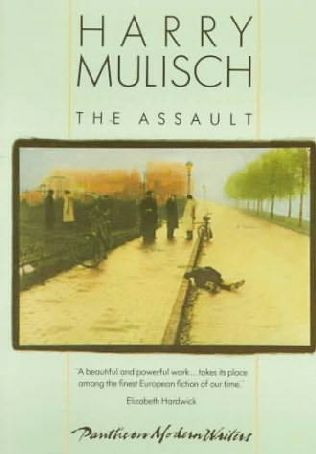
The Assault


Now this is a powerful book. Harry Mulisch's tale of the assassination of a Nazi collaborator in wartime Holland and its effect on a 12-year-old whose family was executed in reprisal plumbs the depths of guilt and integrity in the face of adversity.

The Dutch author deftly sketches the incident and its aftermath in a translation so graceful you'd never guess it wasn't written originally in English. The evocation of sleepy Haarlem, the want and terror of the occupation, the frightening suddenness of the assault, the swiftness of the consequences -- all this sets the stage for the long denoument in the life of Anton Steenwijk.

As in a parable, Anton, who tries to put the horrible events of a single night into a forgotten past, is drawn into encounters that illuminate the full ambivalence of what actually happened -- with neighbors who witnessed his parents' execution, with the son of the collaborator who was assassinated, with the resistance fighter who took part in the assault, and finally with the neighbors who moved the body from in front of their house to Anton's house and unleashed the fury of the Nazis on his family.

He discovers the truth behind the mystery of the woman who provided succor to a traumatized boy on the night of the assault, transforming his life yet again. As the final piece of the puzzle falls into place, he realizes how right he was not to desire or seek revenge for the injustice that befell his family.

There are passages of limpid beauty and breathtaking insight in this compact book. As Anton pursues his medical career in postwar Holland, he feels a detachment from society as a result of this wartime trauma. He votes Social Democratic and then switches his affiliation to a party that claims there is no difference between left and right. "Still, national politics meant little to him: about as much as paper airplanes would mean to the survivor of a plane crash."

But he is not allowed to maintain this detachment. Anton is forced through the author's artifice to face his past in all its ambiguity and to come to terms with it if he is to have any chance at happiness. All of us, of course, though in much less dramatic fashion, face this same challenge.

Monday, August 30, 2010

A Summons to Memphis


What a delight to read! This Pulitzer Prize winning novel by Peter Taylor tells a story without any linguistic pyrotechnics or artificial "layering," but with the economy of a writer who made his reputation with short stories.

There are many layers, though, as the narrator, Philip Carver, casts back into the family history that culminates in a crisis when his widower father contemplates marriage to a younger woman and his spinster sisters connive to block it.

It is for the daughters a type of revenge, for their father at a critical point in time intervened to spoil marriages for both of them, as he did for his son. The arc of the novel is how the son, the only one to leave the family's Tennessee home to make a career in New York, comes to terms with his father's decision first to transplant the family from Nashville to Memphis, traumatizing all three children, and second to secretly visit the family of his son's girlfriend in Chattanooga to discourage any marriage.

The answer ultimately is that he does not come to terms with it. He speaks of forgiving and forgetting, but he remains emotionally damaged, living in a comfortable relationship with an equally damaged woman that has the narrowest of parameters and stifles any true happiness.

The daughters, who apparently are even less aware of the permanent damage to their emotional lives, succeed in taking their father captive and preventing his remarriage, safeguarding their inheritance but more importantly securing their revenge. But they have even less satisfaction from it than their brother.

The narrator skillfully portrays the father-worship of his three children, which neither the father's own tragedy of being duped by a close friend nor his selfish interference in the lives of his children can diminish. But the damage is plain to see in that none of his children then ever marry or have children.

So it is a story about fathers and daughters, and about fathers and sons, and the problems resulting from a dominating personality who is also narcissistic. There is something for virtually every reader to relate to. It is not uplifting because the narrator's disillusionment and disappointment end in resignation. By the end of the novel, it is the father -- despite the betrayal by his friend and the successful efforts of his children to block his marriage -- who triumphs. He is indomitable. But he dies and leaves a legacy of pain.

Taylor's lucid prose deftly unfolds the layers of emotion and history in this profoundly dysfunctional family. While the narrator retains the reader's sympathy, it is clear by the end of the book that he is not the best judge of what has happened.

It is a quick read, just over 200 pages. The depictions of Memphis and Nashville are entertaining -- I picked this up from my shelf because of our recent trip through Tennessee -- but they are less important than the universal emotions of the family relationships.

Wednesday, April 14, 2010

The Brief Wondrous Life of Oscar Wao


There's many things I like about this book, though I wonder how long it will stick with me. I also wonder whether anybody will be talking about Junot Diaz 10 years from now.

I like the energy, exuberance even, of the language, harnessed to a truly original voice. The admixture of Spanish faithfully reflects the polyglot's tendency to use the best word to describe something, even if it means mixing languages.

I like the portrayal of Dominican life, both in Santo Domingo and New Jersey. The collage of Dominican history, the vivid description of the Trujillo terror, the insider look at another culture are all enriching.

I like the character of Oscar, his nerdiness, his life of comic books and video games. Diaz conveys all this with such authority that you feel like something of a nerd yourself reading it.

There are some things I don't like. I don't think we get inside Oscar enough. The narrator(s) remain detached really, and we have only vague notions of what's going on inside Oscar.

I don't like the author's glorification of the sexual prowess of Dominican men. For, make no mistake about it, while he seems to be making fun of it and couches many of his observations as ironic, there is more braggadocio here than satire. After all, the chief frustration of Oscar's brief life -- hardly wondrous -- is not getting laid, and this frustration arises in great part because of the unapologetic insistence of Yunior and everyone else in Oscar's life that this is the ultimate good in life. (Spoiler alert) So when we learn through a posthumous note that Oscar in fact does achieve this elusive goal -- in an impossibly contrived way -- we can indeed view his life now as wondrous.

There is in fact so little in the book in terms of moral choice -- all the characters are carried along by forces beyond their control, above all the tiresome fuku -- that I suspect it is in fact a superficial novel, dazzling in the virtuosity of its language but not destined for a long shelf life.

Yunior's priapism costs him the love of his life, but he seems to come to terms with it pretty easily. It's not so much that he learns any lessons or makes any choices, he just kind of runs out of energy after sowing his wild oats.

Oscar is pathetic, not tragic. His life is not wondrous, but sad. The other characters remain largely ciphers in a fable.