This horror thriller by Scott Spencer writing as Chase Novak is a real page-turner, as a deep under-current of satire keeps it buoyant.
Miranda July referred to the book in the By the Book column in the NY Times Book Review on Sunday and I was intrigued enough to download it on my Kindle. I interrupted my reading of Gutenberg's Apprentice -- a good book, but somewhat ponderous -- for this romp through Gothic horror in modern Manhattan.
Leslie and Alex Twisden have tried every form of fertility help and are desperate enough to make the trek to Slovenia to see a specialist who has had miraculous success in helping previously infertile couples produce children. Dr. Kis is successful once again and the couple raises the twins Adam and Alice. The narrative resumes when the twins are 10 and at a critical point in their lives.
It was evident from the beginning that Dr. Kis's treatment -- which relied on an injection of "completely organic" extractions and a special serum -- had some peculiar side effects. In using what we later find out are lupine and ursine hormones to enhance fertility, the good doctor transmitted some other physical and psychological traits from the animal kingdom.
Spencer/Novak is having a lot of fun with this book. Modern obsessions about appearances, prestige, food and, well, having children, are all mocked mercilessly. The horror is real enough -- you never know terrible thing is going to happen next -- but much of the narrative is tongue in cheek, with a sly irony that is profoundly satirical. Dr. Kis, after all, and a novel called Breed where the first litter is named with A's.
Spencer is an accomplished writer. His prose breezes along with occasional lyrical flourish as he shifts effortlessly among various points of view interspersed with old-fashioned commentary as an omniscient narrator. The characters are sympathetic and the reader stays with both the parents and the children as the tension between them comes to a head.
It was a good tip.
Friday, January 16, 2015
Wednesday, December 31, 2014
Dominion
It's been a long time since I ripped through a 600-page book as quickly as I did with this alternate history thriller by C.J. Sansom. It's another variation on the theme of Hitler winning the war. This time, Lord Halifax becomes British prime minister in 1940 instead of Churchill and signs a separate peace with Germany.
The story picks up in 1952 as a disaffected civil servant, David Fitzgerald, joins the resistance, led by a Churchill in hiding, opposing the pro-Nazi government of Lord Beaverbrook. He photographs secret documents in the Dominions Office where he works, playing on the affections of a coworker to get access to files. Then he is given a special mission to rescue an Oxford classmate, Frank Muncaster, who has been confined to an asylum after he pushed his brother out a second-floor window in his home. His brother, a scientist working on weapons research in the U.S., had confided information on his project to Frank, who was horrified and went into a rage at the information.
The plot turns on this, admittedly, far-fetched premise, but part of Sansom's artistry is that he convinces the reader to go along with it. If any novelist's task is to make the reader care about his characters, Sansom achieves this with flying colors. He carefully controls the suspense as he takes time to explore extensive backstories not only for David, but for Frank, for David's wife Sarah, and eventually for the German Gestapo agent set on their trail, Gunther Hoth.
David and Sarah have lost their only child, who died in a tumble down the stairs. David learned from his mother on her deathbed that she was Jewish, a fact concealed after her family immigrated to Ireland, making him half-Jewish -- or, as he reminds his friend in the novel, since there is no such thing as a half-Jew in the Nazi world, making him Jewish. The only other person who knows this is his father, safely emigrated to New Zealand, but David lives in fear his secret will be revealed.
Much of the narrative tension comes from the growing strain between David and Sarah, as he pursues his life of secrets and lies. She of course first suspects an affair, and David's mission-related flirtation with his coworker fuels this suspicion. There is also the fragile trust between Frank and David, who was one of Frank's few friends in university. Frank is unstable, an odd child bullied and shunned through school and fearful of the secret he has learned from his brother.
And so the plot progresses through a credibly rendered 1950s London unmarked by the ravages of a war that never took place, with forays to the asylum in Birmingham, and eventually the flight of Frank, David, and his resistance colleagues as they seek to keep Frank and his secret out of clutches of the German, or even the collaborating British.
This builds to a satisfying climax over a couple of hundred pages as the resistance mission scrambles to achieve its goal against the backdrop of an ailing Hitler nearing death and the prospect of civil war in Germany over his succession. Sansom even makes an historic smog in London an important factor in the plot.
Sansom is a skilled writer and the book is a pleasure to read. I had read Dissolution and perhaps another one of the Shardlake novels, set in Elizabethan England, as well as Winter in Madrid, but I am fascinated by these alternate histories. This one bears comparison to Fatherland and is at least as good if not better.
There is evidence of sloppy or nonexistent editing. A car's headlights are turned off twice within the space of a paragraph. We are told one of David's resistance colleagues bonded with Frank after sharing the story of her brother, but then several pages later treated to a scene where she is actually doing the sharing.
But these scarcely interfere with the flow of the narrative, enlivened by sharp sketches of the other characters -- David's pompous superior at work, a Special Branch officer assigned to work with the Gestapo in tracking down Frank, a female resistance operative who falls in love with David while assisting him in the rescue of Frank, complicating his strained relationship with Sarah, and several other skillfully drawn minor characters who don't remain two-dimensional plot devices.
Sansom discloses in passing in the acknowledgements that he was diagnosed with bone marrow cancer during the writing of the book and underwent (apparently successful) treatment, making his accomplishment even more admirable.
The story picks up in 1952 as a disaffected civil servant, David Fitzgerald, joins the resistance, led by a Churchill in hiding, opposing the pro-Nazi government of Lord Beaverbrook. He photographs secret documents in the Dominions Office where he works, playing on the affections of a coworker to get access to files. Then he is given a special mission to rescue an Oxford classmate, Frank Muncaster, who has been confined to an asylum after he pushed his brother out a second-floor window in his home. His brother, a scientist working on weapons research in the U.S., had confided information on his project to Frank, who was horrified and went into a rage at the information.
The plot turns on this, admittedly, far-fetched premise, but part of Sansom's artistry is that he convinces the reader to go along with it. If any novelist's task is to make the reader care about his characters, Sansom achieves this with flying colors. He carefully controls the suspense as he takes time to explore extensive backstories not only for David, but for Frank, for David's wife Sarah, and eventually for the German Gestapo agent set on their trail, Gunther Hoth.
David and Sarah have lost their only child, who died in a tumble down the stairs. David learned from his mother on her deathbed that she was Jewish, a fact concealed after her family immigrated to Ireland, making him half-Jewish -- or, as he reminds his friend in the novel, since there is no such thing as a half-Jew in the Nazi world, making him Jewish. The only other person who knows this is his father, safely emigrated to New Zealand, but David lives in fear his secret will be revealed.
Much of the narrative tension comes from the growing strain between David and Sarah, as he pursues his life of secrets and lies. She of course first suspects an affair, and David's mission-related flirtation with his coworker fuels this suspicion. There is also the fragile trust between Frank and David, who was one of Frank's few friends in university. Frank is unstable, an odd child bullied and shunned through school and fearful of the secret he has learned from his brother.
And so the plot progresses through a credibly rendered 1950s London unmarked by the ravages of a war that never took place, with forays to the asylum in Birmingham, and eventually the flight of Frank, David, and his resistance colleagues as they seek to keep Frank and his secret out of clutches of the German, or even the collaborating British.
This builds to a satisfying climax over a couple of hundred pages as the resistance mission scrambles to achieve its goal against the backdrop of an ailing Hitler nearing death and the prospect of civil war in Germany over his succession. Sansom even makes an historic smog in London an important factor in the plot.
Sansom is a skilled writer and the book is a pleasure to read. I had read Dissolution and perhaps another one of the Shardlake novels, set in Elizabethan England, as well as Winter in Madrid, but I am fascinated by these alternate histories. This one bears comparison to Fatherland and is at least as good if not better.
There is evidence of sloppy or nonexistent editing. A car's headlights are turned off twice within the space of a paragraph. We are told one of David's resistance colleagues bonded with Frank after sharing the story of her brother, but then several pages later treated to a scene where she is actually doing the sharing.
But these scarcely interfere with the flow of the narrative, enlivened by sharp sketches of the other characters -- David's pompous superior at work, a Special Branch officer assigned to work with the Gestapo in tracking down Frank, a female resistance operative who falls in love with David while assisting him in the rescue of Frank, complicating his strained relationship with Sarah, and several other skillfully drawn minor characters who don't remain two-dimensional plot devices.
Sansom discloses in passing in the acknowledgements that he was diagnosed with bone marrow cancer during the writing of the book and underwent (apparently successful) treatment, making his accomplishment even more admirable.
Sunday, December 21, 2014
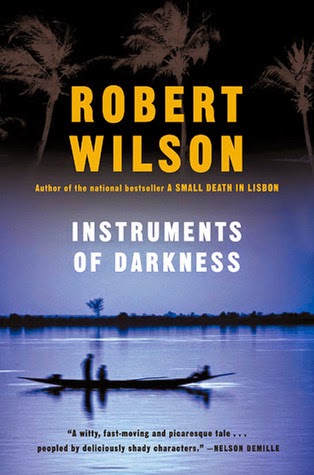
Instruments of Darkness
This noir thriller by Robert Wilson brings the Gold Coast of West Africa to life in all its seedy and seamy glory. The hero, Bruce Medway, shuttles back and forth between Togo, Benin and Ghana, with forays into Nigeria and a glimpse of Ivory Coast, the way the rest of us go to Baltimore or Arlington. The lawless chaos that coexists in the coastal capitals of Lome, Cotonou and Accra with the country club gentility of the white expat population is the ideal setting for a convoluted mystery involving smuggling, drugs, payoffs and treachery.
Wilson is a good writer who makes this background vivid and believable. I enjoyed his bestseller, A Small Death in Lisbon, but was unfamiliar with these earlier thrillers set in Africa until I came upon this book in the second-hand bookstore in Austin, South Congress Books. Apparently they were largely unavailable in the U.S. until the success of Lisbon.
The first-person narration is done with a jaunty, if sometimes forced, humor, but witty enough to make you laugh out loud on occasion. However, none of the characters, including the narrator, elicit any consistent sympathy from the reader. Characters that appear quirky and eccentric eventually are unmasked to be psychopathic or sadistic in a way that requires too much suspension of disbelief. The array of women characters are vampy and have an almost fetishist obsession with smoking. Medway's travails -- a succession of beatings, captivity and brushes with death -- matches Dick Francis's characters in its relentless masochism. Motivations are murky and some characters are strictly utilitarian, fulfilling their role in the plot without engaging the reader.
It is, in short, not a great book, though quite readable. It could be the indelible atmosphere of expat life in West Africa will draw me back to one of the three other novels Wilson sets in this world, but maybe not.
Wilson is a good writer who makes this background vivid and believable. I enjoyed his bestseller, A Small Death in Lisbon, but was unfamiliar with these earlier thrillers set in Africa until I came upon this book in the second-hand bookstore in Austin, South Congress Books. Apparently they were largely unavailable in the U.S. until the success of Lisbon.
The first-person narration is done with a jaunty, if sometimes forced, humor, but witty enough to make you laugh out loud on occasion. However, none of the characters, including the narrator, elicit any consistent sympathy from the reader. Characters that appear quirky and eccentric eventually are unmasked to be psychopathic or sadistic in a way that requires too much suspension of disbelief. The array of women characters are vampy and have an almost fetishist obsession with smoking. Medway's travails -- a succession of beatings, captivity and brushes with death -- matches Dick Francis's characters in its relentless masochism. Motivations are murky and some characters are strictly utilitarian, fulfilling their role in the plot without engaging the reader.
It is, in short, not a great book, though quite readable. It could be the indelible atmosphere of expat life in West Africa will draw me back to one of the three other novels Wilson sets in this world, but maybe not.
Friday, December 12, 2014
An Officer and a Spy
I actually thought this novel by Robert Harris would be a kind of alternate history, like his Fatherland, using the Dreyfus Affair as a springboard for an imaginative historical thriller.
But it is a dramatic retelling of the Dreyfus Affair, based on the voluminous documents and featuring the historical characters -- first and foremost Georges Picquart, the army officer who stubbornly followed the evidence clearing Dreyfus and leading eventually to his exoneration.
As Zola exclaimed at one point in the novel (who knows, perhaps he really said this), "Such a tale has never been told." It is totally gripping. Minute details of the original trial, the second trial that once gain found Dreyfus guilty and the denouement of exoneration, which might have been tedious in less gifted hands, become a mountain of clues worthy of Sherlock Holmes or Perry Mason.
It is told in the first person from Picquart's point of view, so there is no moralizing, no distance, no distractions. It is about the intricate framing of a Jewish officer through misplaced zeal and the determination of an officer, who thought Dreyfus was guilty and was unwittingly even part of the conspiracy to frame him, who was willing to put honor above ambition and follow the trail that showed it was indeed someone else who delivered those trifling secrets to the Germans, that Dreyfus was simply a convenient (Jewish) scapegoat, that the coverup of the this miscarriage of justice was worse than the crime itself.
Picquart is immensely sympathetic, though not unflawed. Dreyfus, on the other hand, is portrayed as decidedly unsympathetic, possessed of a stiff pride and arrogance that did nothing to help his cause. Both were terribly wronged by the army they loved, but both returned to service. Dreyfus actually came out of the reserves to fight in World War I and died in the 1930s. Picquart became Minister of War and was spared the tragedy of the war when he died falling of his horse.
The novel is a lovely map of Paris, each street there today as it was in 1895. Picquart meets Zola, Debussy and a host of other personalities from that period in the City of Light. The glory and shame of France live side by side in this fin-de-siecle cocoon that has such a dark underbelly.
I feel immeasurably enriched to have such a detailed understanding of the Dreyfus Affair. Its role in history can hardly be underestimated and the New York Times had a headline this week about growing anti-semitism in France. Plus ca change!
A wonderful book.
But it is a dramatic retelling of the Dreyfus Affair, based on the voluminous documents and featuring the historical characters -- first and foremost Georges Picquart, the army officer who stubbornly followed the evidence clearing Dreyfus and leading eventually to his exoneration.
As Zola exclaimed at one point in the novel (who knows, perhaps he really said this), "Such a tale has never been told." It is totally gripping. Minute details of the original trial, the second trial that once gain found Dreyfus guilty and the denouement of exoneration, which might have been tedious in less gifted hands, become a mountain of clues worthy of Sherlock Holmes or Perry Mason.
It is told in the first person from Picquart's point of view, so there is no moralizing, no distance, no distractions. It is about the intricate framing of a Jewish officer through misplaced zeal and the determination of an officer, who thought Dreyfus was guilty and was unwittingly even part of the conspiracy to frame him, who was willing to put honor above ambition and follow the trail that showed it was indeed someone else who delivered those trifling secrets to the Germans, that Dreyfus was simply a convenient (Jewish) scapegoat, that the coverup of the this miscarriage of justice was worse than the crime itself.
Picquart is immensely sympathetic, though not unflawed. Dreyfus, on the other hand, is portrayed as decidedly unsympathetic, possessed of a stiff pride and arrogance that did nothing to help his cause. Both were terribly wronged by the army they loved, but both returned to service. Dreyfus actually came out of the reserves to fight in World War I and died in the 1930s. Picquart became Minister of War and was spared the tragedy of the war when he died falling of his horse.
The novel is a lovely map of Paris, each street there today as it was in 1895. Picquart meets Zola, Debussy and a host of other personalities from that period in the City of Light. The glory and shame of France live side by side in this fin-de-siecle cocoon that has such a dark underbelly.
I feel immeasurably enriched to have such a detailed understanding of the Dreyfus Affair. Its role in history can hardly be underestimated and the New York Times had a headline this week about growing anti-semitism in France. Plus ca change!
A wonderful book.
Monday, December 8, 2014
The Water's Edge
Karin Fossum is not just another Scandinavian writer cashing in on the current fashion for detective stories from that region. Her spare, direct narration has more in common with classic hardboiled than with the florid Stieg Larsson, and only slightly less florid Jo Nesbo. Her Oslo detective, Konrad Sejer, does not suffer the inner torment of a Kurt Wallander or Harry Hole or Erlandur.
Fossum sketches in the bleak northern landscapes that are so essential to Scandinavian noir. But her focus is more on the quirky relationships that alternate between terse exchanges and more extended riffs between characters. One of her hallmarks, apparently, is the time she spends with minor characters -- as, in this instance, with the couple who find the body of the abused boy that opens this case. We see much more the interior life of the wife, Kristine Ris, than we do of Sejer himself. And in many ways, the novel is as much her story as it is Sejer's and his effort to solve the mystery of first one pedophile killing and then the disappearance of a second boy.
But Sejer's conversations with his Dr. Watson, Jacob Skarre, on why they became policemen and what is the positive contribution they can make are also entertaining, and somehow manage not to interrupt the flow of the narrative, but in fact let the reader catch his breath before galloping off after the next clue.
Another hallmark of Fossum's tales, it seems, is some sympathy for the villain. She neatly creates the circumstances that contribute to their flaws without any liberal, heart-on-sleeve gushing. It is Sejer's insight into this human condition that enables him to unravel the mystery, ignore the red herrings, double back on overlooked clues, and try to mend the damage to those who are not directly the victims of the crime -- or rather the killing, but it is not sure in some cases that a crime has been committed.
Sejer tracks down the perpetrator of the deaths in this mystery. Fossum leaves some sympathy for them as well as for other characters who might just as easily have found themselves branded as criminals if they had been equally unlucky and in the wrong place at the wrong time. I'm curious now to read a second Fossum novel with Sejer to see how many of these traits are repeated.
Fossum sketches in the bleak northern landscapes that are so essential to Scandinavian noir. But her focus is more on the quirky relationships that alternate between terse exchanges and more extended riffs between characters. One of her hallmarks, apparently, is the time she spends with minor characters -- as, in this instance, with the couple who find the body of the abused boy that opens this case. We see much more the interior life of the wife, Kristine Ris, than we do of Sejer himself. And in many ways, the novel is as much her story as it is Sejer's and his effort to solve the mystery of first one pedophile killing and then the disappearance of a second boy.
But Sejer's conversations with his Dr. Watson, Jacob Skarre, on why they became policemen and what is the positive contribution they can make are also entertaining, and somehow manage not to interrupt the flow of the narrative, but in fact let the reader catch his breath before galloping off after the next clue.
Another hallmark of Fossum's tales, it seems, is some sympathy for the villain. She neatly creates the circumstances that contribute to their flaws without any liberal, heart-on-sleeve gushing. It is Sejer's insight into this human condition that enables him to unravel the mystery, ignore the red herrings, double back on overlooked clues, and try to mend the damage to those who are not directly the victims of the crime -- or rather the killing, but it is not sure in some cases that a crime has been committed.
Sejer tracks down the perpetrator of the deaths in this mystery. Fossum leaves some sympathy for them as well as for other characters who might just as easily have found themselves branded as criminals if they had been equally unlucky and in the wrong place at the wrong time. I'm curious now to read a second Fossum novel with Sejer to see how many of these traits are repeated.
Saturday, October 18, 2014
The Dog
Joseph O'Neill's novel is a brilliant satire on many levels.
He is bitingly, nastily funny about expatriate life in Dubai, sparing neither
the foreigners nor the natives. By the same token, the legal and financial
professions, globally operating millionaire families, "family
offices," consulting, all become objects of the author's derision.
At a deeper level, however, the books is a frightening take
on the loss of integrity and even of identity in a world fractured by the
Internet and social networking. The unnamed narrator sends imaginary e-mails;
obsessively googles his ex-girlfriend, stopping only when he fails to find her
among the persons bearing her name; becomes himself the victim of “search
libel” as malicious googlers manipulate the autocomplete algorithm so that his
distinctive name comes up with “embezzlement,” “sexual harassment,” and other
diatribes attached to it.
I wrote in a recent WIRoB blog post that historical and
post-apocalyptic novels are so popular these days because it allows the authors
to strip away the distractions of contemporary life that make it so diffuse.
O’Neill, however, has succeeded in making that the subject of his novel.
All this rendered in a perpetually dazzling language that is
so dense that even the relatively short book can take some time to read.
There is not much of a plot. Rather, the action is more like
the twist of a kaleidoscope that throws the jumble of the hero’s life into a
new pattern. A lawyer, the narrator leaves a job that has become uncomfortable
after he breaks up with his girlfriend to become the Dubai-based director of a
“family office” for the extended family of an old Levantine friend.
Inevitably, for all his pride in fashioning disclaimers and
limiting his legal liability, he become involved in a probe of family dealings
that leaves him vulnerable and exposed.
The disappearance of a casual friend that the narrator knows
from scuba diving, Ted Wilson, appears to drive the narrative at the beginning,
as it emerges that the friend was a closet bigamist, lending a certain
fascination to the American wife who comes to Dubai in search of her husband
only to leave disillusioned when a second wife surfaces there.
But this vanish person is really just another metaphor for
the loss of self, and the hero’s fascination for Mrs. Ted Wilson is part of a
fantasy life that blurs with real life through the power of the Web.
The narrative is one long interior monologue, with
flashbacks gradually filling in the background that led to the hero’s presence
in Dubai. It is unsparingly frank, as the hero discloses his activities with
pornography and prostitutes, his own feelings of inadequacy, how he was in fact
“cheating” on his girlfriend by withholding any emotional interaction.
Beneath it all, however, he is somehow searching for a shred
of authenticity, if not exactly integrity. As the denouement approaches, he
faces the choice of being bounced again to another country by events seemingly
beyond his control, or accepting consequences that would in a technical sense
be unjust.
He takes inspiration, in a final burst of irony from the
author, in the example of Conrad Black, the newspaper magnate who was
eventually jailed for a number of financial crimes. Imprisonment, the narrator
muses, at least puts a limit to culpability. “It’s certainly true that so long
as he’s inside, he can hardly be punished more.”
Netherland was a
book about expatriates and rootlessness as well. Though different in style,
this book is thematically very much in keeping with the other. To examine these
themes, so topical in our times, in such wildly variant fashion is a virtuoso
performance by the author.
Wednesday, October 8, 2014
Catching up
I've been neglecting my blogs. This is due in part to being busy with work. Also, I have the feeling blogging is a bit passe. And for this blog in particular I had gotten into a rut of viewing it as a book review blog, rather than a reading blog.I have been posting only when I finish a book and if there are any readers they must be amazed at how few books I read. I don't read enough, but I read more books than I finish. For my book group, for instance, I usually make an effort to read some of the book, but I haven't finished that many.
I really liked Empire of the Summer Moon by S.C. Gwynne and read a good half of it. I loved his historical sense, his authoritative chronicle of the Comanches and the early Texas settlers and his vivid descriptions of the terrain. In our book group discussion, several participants said it went downhill in the second part with the actual description of Quanah Parker. That gave me little incentive to want to finish the book.
I also liked Night Soldiers by Alan Furst. I read about a third of it and may get back to it. Some book group members found it too brutal. I have to admit I was losing sympathy for the main character, as I often do for Furst's main character (liking is one thing, sympathy another). I did, however, appreciate his depiction of the deplorable Stalinist mentality, where the practice is so at odds with the ideal. The hero's recruiter in the Bulgarian village represented the ideal, while his training in the NKVD was the reality.
I've also been doing more reviews for the Washington Independent Review of Books -- two thrillers I was not too excited about. The first was Marc Levy's Replay, which was really juvenile, and the second was Ben Mezrich's Seven Wonders, which was more entertaining but pretty shallow. I've signed up for another one, The Empire of the Night by Robert Olen Butler, which will interrupt my reading of The Dog by Joseph O'Neill, a book I really like and will finish and review here.
Also, I've been writing a monthly blog for WIRoB, Words for Thought, which are musings about reading and how books fit into our cultural milieu.
So I am doing a considerable amount of reading, and some writing about it that doesn't appear here. I've decided to be more flexible about what and when I write here, so my posting should be more frequent -- at least until I give up on blogging altogether.
Subscribe to:
Posts (Atom)