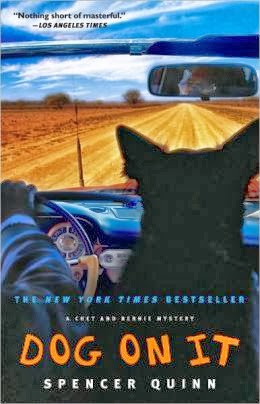
Spencer Quinn's series of detective stories narrated by the dog Chet gives new meaning to the expression, "It's a dog's life." What makes these novels so addictive, aside from just the wit and entertainment provided, is the chance to see life from a dog's point of view. And, as Chet would say, "Life is good." He doesn't have to worry about the finances of the Little Detective Agency being in a mess (his human partner, Bernie, doesn't seem to worry much, either). Such worries as he does have evaporate as soon as a treat or a scent or a pat on the head intervenes. It's nice to put yourself in his paws, so to speak.
In this book, the first of the series, Bernie and Chet have to find a missing teenage girl whose parents are divorced. The plot has some of the same elements as The Sound and the Furry, with Chet at some point being separated from Bernie and at another point playing a key role in rescuing him.
In both cases of separation, Quinn reminds you how vulnerable dogs are in a human world. It is not really that hard to restrain them and once restrained, they are limited in how they can react. Then, if they do manage to escape and rejoin their human master -- as Chet presumably always succeeds in doing -- they can't tell you anything about it.
The climax in both books comes when Chet gets a chance to spring, literally, into action. This of course, as we know from Rin Tin Tin, is where dogs come into their own. Their speed, their strength, their single-mindedness is what makes them such formidable partners. Teeth help, too.
All that said, I will try to take a break from the series, partly to keep from finishing them off too quickly and partly to keep that endearing freshness. I did read the little squib e-short story, "A Cat Was Involved," which fills in the back story of how Chet and Bernie met. However, it was a half-baked effort to cash in on the series popularity and the story actually worked better when it was suggestive, rather than have all the details filled in.
Sunday, October 13, 2013
Thursday, October 10, 2013
God's Crucible
This nonfiction book by David Levering Lewis is subtitled "Islam and the Making of Europe, 570-1215," so it illuminates what we treated only briefly in school as the Dark Ages. Lewis's dense narrative is authoritative and comprehensive, and I found what I read of it intriguing and enlightening.
However, it is a dry and essentially academic book so my sessions usually ended with me falling asleep in the chair and I was only able to read "in" it. Some of our book club members were much more thorough. They generally concluded it is indeed interesting to see that period of Europe from the "other" side, but found Lewis a bit too glowing in his descriptions of Islam's contributions and a bit too negative about Europe.
When one of our members read a passage about how Europe might have been happier if Charles Martel had lost at Poitiers, given the years of feudalism that lay ahead in Europe, my question was whether now in the 21st century one would be happier in Europe or Saudi Arabia. In both cases, there has been an organic evolution from the 8th century. Nor was the intervening period in Europe without its accomplishments.
I can't say whether this book explains where Islam went wrong, but no one in the group mentioned any explanations. In discussing how much further advanced the Muslims were in the arts and sciences than Western Europe in this period, I made the point that everyone was more advanced -- the Byzantines, the Alexandrians, and the Persians whose defeat opened up the Middle East for the Islamic jihad. There is no indication that something intrinsic about Islam lends itself to creativity and innovation in the social sciences -- rather the opposite.
The book launched us into a discussion about the influence of religion in general. Why are the major religions that still dominate globally all so old? Does religion really drive events or do political leaders use religion to bind and motivate their followers? We agreed that religion as a touchstone of ethical values and as community were probably as important as belief in the supernatural in perpetuating these old and often reactionary institutions.
However, it is a dry and essentially academic book so my sessions usually ended with me falling asleep in the chair and I was only able to read "in" it. Some of our book club members were much more thorough. They generally concluded it is indeed interesting to see that period of Europe from the "other" side, but found Lewis a bit too glowing in his descriptions of Islam's contributions and a bit too negative about Europe.
When one of our members read a passage about how Europe might have been happier if Charles Martel had lost at Poitiers, given the years of feudalism that lay ahead in Europe, my question was whether now in the 21st century one would be happier in Europe or Saudi Arabia. In both cases, there has been an organic evolution from the 8th century. Nor was the intervening period in Europe without its accomplishments.
I can't say whether this book explains where Islam went wrong, but no one in the group mentioned any explanations. In discussing how much further advanced the Muslims were in the arts and sciences than Western Europe in this period, I made the point that everyone was more advanced -- the Byzantines, the Alexandrians, and the Persians whose defeat opened up the Middle East for the Islamic jihad. There is no indication that something intrinsic about Islam lends itself to creativity and innovation in the social sciences -- rather the opposite.
The book launched us into a discussion about the influence of religion in general. Why are the major religions that still dominate globally all so old? Does religion really drive events or do political leaders use religion to bind and motivate their followers? We agreed that religion as a touchstone of ethical values and as community were probably as important as belief in the supernatural in perpetuating these old and often reactionary institutions.
Saturday, October 5, 2013
The Sound and the Furry
I'm hooked. Hokey as the books may sound, Spencer Quinn's Bernie and Chet series, narrated by the canine member of the partnership, Chet the Jet, has captivated me.
It's not only Quinn's rendering of the doggy viewpoint, which is something of a tour de force, it is the Carl Hiassen-level humor he employs in narrating his simple mysteries. I use the plural, even though I've only read the one, the latest, because I'm confident the same mastery is maintained throughout the series.
It is of course a sleight of hand to have a dog narrate a story using vocabulary much more sophisticated than what he professes to not understand in the dialogue. But like any good illusionist, Quinn distracts you from this conundrum with his portrayal of Chet living in the moment, losing his thread of "thought," getting distracted by anything remotely resembling food. There is Chet's total lack of self-awareness, so that even as he's narrating the story he becomes aware of his instinctive actions -- barking, growling, snatching a chicken wing, carrying a straw hat away with him -- only when Bernie calls him on it.
Anyone who has spent time with a dog, interacted with a dog, or who just likes animals can't help but appreciate the consistency with which Quinn portrays the simple joie de vivre of the narrator. Whatever depredations the human characters engage in, the reader feels upbeat because Chet feels upbeat.
Bernie Little is not that much different than your typical PI -- flawed, undisciplined, broke -- but seen through the prism of Chet's narration, his heroic side comes to the fore. Not that he's any more heroic than the rest of us, but he is a hero in Chet's eyes, and it's contagious.
The plot itself is not half-bad. You scarcely notice, immersed as you are in Chet's being in the moment, that the plot is moving along, clues are being uncovered, red herrings identified, villains chased down and clients rescued. In this case, Bernie and Chet go to Louisiana bayou country to find a missing person and unravel a mystery involving a ton of stolen shrimp and birds dying of petroleum immersion.
Bernie's choice of vehicle -- a well-used Porsche -- is a plus because it reminds me of my brief ownership of a well-used Porsche. There is little description of Chet in this book -- perhaps there is more detail in the earlier books -- beyond the fact that he weighs 100 pounds-plus. So I have taken to imagining him as a shaggy German shepherd mutt. Once, when he sees Bernie and himself in a mirror, Chet is amazed, saying it looked like Bernie with a tough-looking member of the nation within (Chet's expression for the parallel dog population), realizing only belatedly that it's -- ME.
So I've already downloaded the first book of the series, Dog on It, and will work my way forward. I'm hoping I'll be able to ration them and not just binge-read the whole series.
Spencer Quinn is a pen name for Peter Abrahams, who has written numerous thrillers and young adult books under his own name. Stephen King is a fan and listed four of his novels in his book recommendations in On Writing. So now I've downloaded Lights Out as well.
It's not only Quinn's rendering of the doggy viewpoint, which is something of a tour de force, it is the Carl Hiassen-level humor he employs in narrating his simple mysteries. I use the plural, even though I've only read the one, the latest, because I'm confident the same mastery is maintained throughout the series.
It is of course a sleight of hand to have a dog narrate a story using vocabulary much more sophisticated than what he professes to not understand in the dialogue. But like any good illusionist, Quinn distracts you from this conundrum with his portrayal of Chet living in the moment, losing his thread of "thought," getting distracted by anything remotely resembling food. There is Chet's total lack of self-awareness, so that even as he's narrating the story he becomes aware of his instinctive actions -- barking, growling, snatching a chicken wing, carrying a straw hat away with him -- only when Bernie calls him on it.
Anyone who has spent time with a dog, interacted with a dog, or who just likes animals can't help but appreciate the consistency with which Quinn portrays the simple joie de vivre of the narrator. Whatever depredations the human characters engage in, the reader feels upbeat because Chet feels upbeat.
Bernie Little is not that much different than your typical PI -- flawed, undisciplined, broke -- but seen through the prism of Chet's narration, his heroic side comes to the fore. Not that he's any more heroic than the rest of us, but he is a hero in Chet's eyes, and it's contagious.
The plot itself is not half-bad. You scarcely notice, immersed as you are in Chet's being in the moment, that the plot is moving along, clues are being uncovered, red herrings identified, villains chased down and clients rescued. In this case, Bernie and Chet go to Louisiana bayou country to find a missing person and unravel a mystery involving a ton of stolen shrimp and birds dying of petroleum immersion.
Bernie's choice of vehicle -- a well-used Porsche -- is a plus because it reminds me of my brief ownership of a well-used Porsche. There is little description of Chet in this book -- perhaps there is more detail in the earlier books -- beyond the fact that he weighs 100 pounds-plus. So I have taken to imagining him as a shaggy German shepherd mutt. Once, when he sees Bernie and himself in a mirror, Chet is amazed, saying it looked like Bernie with a tough-looking member of the nation within (Chet's expression for the parallel dog population), realizing only belatedly that it's -- ME.
So I've already downloaded the first book of the series, Dog on It, and will work my way forward. I'm hoping I'll be able to ration them and not just binge-read the whole series.
Spencer Quinn is a pen name for Peter Abrahams, who has written numerous thrillers and young adult books under his own name. Stephen King is a fan and listed four of his novels in his book recommendations in On Writing. So now I've downloaded Lights Out as well.
Sunday, September 29, 2013
Operation Napoleon
After Steve Berry's sunny romp through Tudor monuments in London, I was ready for some Icelandic winter and Arnaldur Indridason provides it, in spades, in this thriller outside his Erlendur series.
Wikipedia, by the way, tells me that Indridason is a patronymic, not a surname, and the correct second reference to the author is Arnaldur. Which explains why his heroine in Operation Napoleon is referred to by everyone simply by her first name, Kristin, with never a surname. I supposed it explains why Erlendur just has a single name, too.
The glacier is the most compelling character in a thriller that goes pretty much by the numbers. But that is a big plus, because, as I've mentioned before (Arctic Chill), this brooding Nordic atmosphere has a lot of appeal for me. The other immediately noticeable difference from the Berry book is that the language, even in translation, is earthier, more robust. I knew a scholar once who was immersed in ancient Icelandic and other Germanic-root languages, and I think there's an Anglo-Saxon resonance here that is missing from our pasteurized American language.
Otherwise, Arnaldur is lucky he stumbled onto Erlendur, because it allowed him to take his writing to another level and make the breakthrough to an international audience that he would never have reached with more books like this one. The only characters with any dimension to them are the Icelandic characters, and they are in the minority. We have a cast of Americans who struggle to reach two dimensions, and one, Kristin's romantic interest, Steve, who is so flat he is virtually invisible. When he (*spoiler alert*) finally meets his demise, the reader feels absolutely nothing (and Kristin's grief hardly seems heartfelt).
The plot itself is another alternative history. Spoiler alert only for those who are easily surprised -- Operation Napoleon is about a World War II plot to spirit he who shall not be named to a remote island exile rather than death in a Berlin bunker. Arnaldur has some fun playing with a cargo of Jewish gold or plundered art as disinformation regarding the German Junker plane that crashed on an Icelandic glacier in the waning days of the war and whose recovery in 1999 was the obsessive goal of American military intelligence.
In any case, the spunky heroine's ability to elude trained assassins and baffle the not-so-intelligent military is the thin plot that plays out against the dramatic background of Iceland's winter. Nor is it exactly a Hollywood ending for said heroine. Even though she survives her ordeal, her life is permanently marked by her experience.
Arnaldur has the opportunity to air Icelandic grievances about American high-handedness and arrogance in a vastly unequal "alliance" (it's like saying Finland was an "ally" of the Soviet Union), and it's fine to let the mouse have his little roar. In the end, he is no harder on the U.S. government apparatus than our own thriller writers. The politics stops just short of being distracting, but suffice it to say, the writer is on much firmer ground with his Erlendur procedurals than with an imitation thriller.
Wikipedia, by the way, tells me that Indridason is a patronymic, not a surname, and the correct second reference to the author is Arnaldur. Which explains why his heroine in Operation Napoleon is referred to by everyone simply by her first name, Kristin, with never a surname. I supposed it explains why Erlendur just has a single name, too.
The glacier is the most compelling character in a thriller that goes pretty much by the numbers. But that is a big plus, because, as I've mentioned before (Arctic Chill), this brooding Nordic atmosphere has a lot of appeal for me. The other immediately noticeable difference from the Berry book is that the language, even in translation, is earthier, more robust. I knew a scholar once who was immersed in ancient Icelandic and other Germanic-root languages, and I think there's an Anglo-Saxon resonance here that is missing from our pasteurized American language.
Otherwise, Arnaldur is lucky he stumbled onto Erlendur, because it allowed him to take his writing to another level and make the breakthrough to an international audience that he would never have reached with more books like this one. The only characters with any dimension to them are the Icelandic characters, and they are in the minority. We have a cast of Americans who struggle to reach two dimensions, and one, Kristin's romantic interest, Steve, who is so flat he is virtually invisible. When he (*spoiler alert*) finally meets his demise, the reader feels absolutely nothing (and Kristin's grief hardly seems heartfelt).
The plot itself is another alternative history. Spoiler alert only for those who are easily surprised -- Operation Napoleon is about a World War II plot to spirit he who shall not be named to a remote island exile rather than death in a Berlin bunker. Arnaldur has some fun playing with a cargo of Jewish gold or plundered art as disinformation regarding the German Junker plane that crashed on an Icelandic glacier in the waning days of the war and whose recovery in 1999 was the obsessive goal of American military intelligence.
In any case, the spunky heroine's ability to elude trained assassins and baffle the not-so-intelligent military is the thin plot that plays out against the dramatic background of Iceland's winter. Nor is it exactly a Hollywood ending for said heroine. Even though she survives her ordeal, her life is permanently marked by her experience.
Arnaldur has the opportunity to air Icelandic grievances about American high-handedness and arrogance in a vastly unequal "alliance" (it's like saying Finland was an "ally" of the Soviet Union), and it's fine to let the mouse have his little roar. In the end, he is no harder on the U.S. government apparatus than our own thriller writers. The politics stops just short of being distracting, but suffice it to say, the writer is on much firmer ground with his Erlendur procedurals than with an imitation thriller.
The King's Deception
But it's enough for me. I enjoy thrillers about odd historical twists and can put up with undistinguished writing as long as it's not clumsy. The book has historic locales aplenty. In fact, Berry even acknowledges in a writer's note that he was able to add more because that volcanic ash from Iceland that year kept him in London three days longer than he planned. So if Cotton Malone's odyssey during the novel seems a bit random and arbitrary, it's because it is. So we see Hampton Court and the Tower of London and the Middle Temple of the Inns of Court, and get to visit some underground sewers.
It hardly requires a spoiler alert to divulge that the premise of the book is that Elizabeth I was an impostor. The real princess died in her teens and the impostor who succeeded to the throne was in fact her illegitimate nephew -- and a man. All the usual arguments -- the fact that Elizabeth never married, was known as the virgin queen, wore clothes that disguised her figure, never let anyone touch her or doctors examine her, insisted that portraits show her as a 25-year-old -- are marshaled to support the thesis.
Well and good, though the plot Berry has concocted around this kernel of alternative history is pretty far-fetched. A CIA operative of dubious character is pursuing the truth about Elizabeth in order to blackmail the British government into not granting a compassionate early release to the Lockerbie terrorist, diagnosed with terminal cancer. While this is clearly a true outrage for the author and his characters, Berry may be overestimating its power as a spring for this kind of plot.
But it gets worse. The reason the British would be susceptible to this blackmail is because the truth would render Elizabeth's reign illegitimate, and call into question the legitimacy of all her actions, especially the leases she gave in the Irish counties that now constitute Northern Ireland. In short, all hell would break loose because Irish nationalists would discover a new reason to challenge the British presence there. Berry may also be overestimating the devotion of the British to the rule of law, or at least the ability of American readers to suspend disbelief about such an improbable consequence.
The villainous and manipulative head of MI-6, or, as Berry snarkily insists, the SIS, to call it by its proper British name, is a knight of the realm, though anything but chivalrous. The CIA operative turns out to be ot only a cad, but a traitor and meets the fate that thriller writers have for his ilk. The female British agent from the Serious Organized Crime Agency who goes rogue from her service to help Malone is as bland and two-dimensional as her name, Kathleen Richards, would suggest. There is no romance in the novel, and Berry tells us in the Epilogue that the brief fling she and Cotton had afterwards was just that, no doubt keeping things open for Malone in a later episode to finally be reunited with his long-suffering ex-wife.
I was in the mood for some light reading, and it doesn't get any lighter than this.
Friday, September 20, 2013
Beautiful Ruins
Jess Walter's masterpiece is the rare book you feel should not be reviewed beyond just saying: Read it. I've been a fan of his since Citizen Vince and even went back to read one of his early Spokane detective stories, but Beautiful Ruins raises his work to a new level.
The fabulously layered novel depicts the intertwining of two, three, five and even six lives after a chance encounter in Porto Vergogna, the fictional sixth Terre Cinque, and the runt of the litter. The owner and manager of the Hotel Adequate View is hoping to attract American tourists when a young actress diagnosed as mortally ill comes to stay at his little hotel. What follows is something between a romp and an epic that combines biting satire, incredibly poignant insights into human relationships, and above all a story about how each individual must come to terms with regret.
It is not a sound-bite type of novel but a couple of lines in the excruciatingly elegant climax tell you much about the book: "At that moment, Pasquale Tursi [one of the two main characters] felt wrenched in two. His life was two lives now: the life he would have and the life he would forever wonder about."
A few pages and decades later, Dee Moray/Debra Moore, the other main character, reflects on whether she is at peace or not: "But other times, honestly, the whole idea of being at peace just pisses her off. At peace? Who but the insane would ever be at peace? What person who has enjoyed life could possibly think one is enough? Who could live even a day and not feel the sweet ache of regret?"
Wise enough out of context, these brief quotes are like a mule kick in the narrative. Walter skips through time and place, through points of view, darting from Liguria to Hollywood, to Rome and London and Edinburgh, to Idaho and Seattle, to the American frontier and the retreating Germany army, never once losing the reader or the thread of a narrative of human emotions -- hope, betrayal, forlorn love, unrequited love, death, loss, and above all the realization that your intentions are not always aligned with your actions, that this is the human condition and that you must live with it. There are choices, they have consequences, but there are also many things outside our control that will determine our lives. But they are always our lives.
The author's use of the movie "Cleopatra" and the raging love affair between Richard Burton and Elizabeth Taylor as a pillar of the plot and a meme for life itself is brilliant, and particularly telling for someone like me who lived through the hype at the time. On top of everything else, I actually encountered Burton the summer I interned at AP (1974) when I was sent to join the press mob greeting him when he stepped off a ship at the New York pier. Walter's depiction of Burton as the deeply flawed human being behind the great actor must stand as one of the best portraits of him in fiction.
And yet Burton, though he plays a major role, is a minor character in this sweeping novel which at one time or another deftly portrays an aging Hollywood producer determined to make a comeback, a wannabe screenwriter who learns the art of pitching, an ambitious but ambivalent production assistant, a lost but talented musician, a would-be novelist whose magnum opus is a single opening chapter and a cast of minor characters who nonetheless have vivid personalities of their own.
What more can you ask for from a 337-page novel?
The fabulously layered novel depicts the intertwining of two, three, five and even six lives after a chance encounter in Porto Vergogna, the fictional sixth Terre Cinque, and the runt of the litter. The owner and manager of the Hotel Adequate View is hoping to attract American tourists when a young actress diagnosed as mortally ill comes to stay at his little hotel. What follows is something between a romp and an epic that combines biting satire, incredibly poignant insights into human relationships, and above all a story about how each individual must come to terms with regret.
It is not a sound-bite type of novel but a couple of lines in the excruciatingly elegant climax tell you much about the book: "At that moment, Pasquale Tursi [one of the two main characters] felt wrenched in two. His life was two lives now: the life he would have and the life he would forever wonder about."
A few pages and decades later, Dee Moray/Debra Moore, the other main character, reflects on whether she is at peace or not: "But other times, honestly, the whole idea of being at peace just pisses her off. At peace? Who but the insane would ever be at peace? What person who has enjoyed life could possibly think one is enough? Who could live even a day and not feel the sweet ache of regret?"
Wise enough out of context, these brief quotes are like a mule kick in the narrative. Walter skips through time and place, through points of view, darting from Liguria to Hollywood, to Rome and London and Edinburgh, to Idaho and Seattle, to the American frontier and the retreating Germany army, never once losing the reader or the thread of a narrative of human emotions -- hope, betrayal, forlorn love, unrequited love, death, loss, and above all the realization that your intentions are not always aligned with your actions, that this is the human condition and that you must live with it. There are choices, they have consequences, but there are also many things outside our control that will determine our lives. But they are always our lives.
The author's use of the movie "Cleopatra" and the raging love affair between Richard Burton and Elizabeth Taylor as a pillar of the plot and a meme for life itself is brilliant, and particularly telling for someone like me who lived through the hype at the time. On top of everything else, I actually encountered Burton the summer I interned at AP (1974) when I was sent to join the press mob greeting him when he stepped off a ship at the New York pier. Walter's depiction of Burton as the deeply flawed human being behind the great actor must stand as one of the best portraits of him in fiction.
And yet Burton, though he plays a major role, is a minor character in this sweeping novel which at one time or another deftly portrays an aging Hollywood producer determined to make a comeback, a wannabe screenwriter who learns the art of pitching, an ambitious but ambivalent production assistant, a lost but talented musician, a would-be novelist whose magnum opus is a single opening chapter and a cast of minor characters who nonetheless have vivid personalities of their own.
What more can you ask for from a 337-page novel?
Monday, September 16, 2013
Basilica
It seemed like a good idea to finally read this thriller that begins with a priest falling to his death from the dome of St. Peter's shortly before re-visiting the basilica for the first time in 20-some years. And this novel by newspaperman William Montalbano has the other distinction of anticipating the election of a Latino pope by a decade and a half.
The church portrayed by Montalbano is a flawed, very human institution. His protagonist, former Miami cop Paul Lorenzo, is somewhat casual about his vow of chastity in his new vocation as a lay brother. The suggestion is that most churchmen are not faithful to their vows and chastity is probably an outmoded idea, anyway. Lorenzo sought refuge in an order -- never really a good motivation -- because he botched an escort for a Latin American cardinal, stole a million dollars in drug money that fell into his hands as a result, and lost his wife and daughter in a kidnapping-hostage taking when the drug gang sought revenge.
That Latin American cardinal becomes Pope Pius XIII and Lorenzo becomes a fixer for the new pope, who goes by "Tredi" for the Italian for thirteen (tredicemo). The pope himself is a target for the drug gang's revenge and thwarting their plans drives the plot.
Montalbano, who died prematurely of a heart attack before this book was published, was a prize-winning journalist and a good writer. He spent seven years as the Vatican correspondent for the Los Angeles Times after many years covering Latin America, so he knows the world he describes from firsthand experience.
But when it comes to portraying churchmen and religious life, it is clear that his firsthand experience is as an outsider. It is fine to be cynical and worldly wise about the motivations and behavior of clerics, but it fails to do justice to the genuine idealism and altruism you find among those who dedicate their lives to God and manage to maintain their integrity. It might make the reader feel in the know when Brother Paul sleeps with his on-again, off-again girlfriend -- a former nun -- but there is a whole dimension missing in this depiction of the faithful. It may be well observed that religious life is just another career for many, but for others it is truly a life of faith, and there is no hint of that in Montalbano's characters.
Even the pope, despite his penchant for working the occasional miracle, seems to keep his faith at arm's length, like the cassock he takes on and off.
Brother Paul, then, who was a royal screw-up as a policeman, husband and father, and is anything but a model religious as he gets a chance at redemption, is a hard sell for the reader's sympathy. The plot itself is an improbable mix of the by-now standard drug cartel by-play and dirty Vatican politics. The identity of the eventual papal assassin is clear from the moment he enters the story, and only someone with Lorenzo's track record for slow-wittedness would have missed it.
The climactic scene in Umbria -- I read the book on a vacation to Umbria and Rome -- is somewhat contrived and fairly low-key as a climax. I left the book at the house we rented. It's fine for the airplane or for a vacation when you're looking for some mindless entertainment.
The church portrayed by Montalbano is a flawed, very human institution. His protagonist, former Miami cop Paul Lorenzo, is somewhat casual about his vow of chastity in his new vocation as a lay brother. The suggestion is that most churchmen are not faithful to their vows and chastity is probably an outmoded idea, anyway. Lorenzo sought refuge in an order -- never really a good motivation -- because he botched an escort for a Latin American cardinal, stole a million dollars in drug money that fell into his hands as a result, and lost his wife and daughter in a kidnapping-hostage taking when the drug gang sought revenge.
That Latin American cardinal becomes Pope Pius XIII and Lorenzo becomes a fixer for the new pope, who goes by "Tredi" for the Italian for thirteen (tredicemo). The pope himself is a target for the drug gang's revenge and thwarting their plans drives the plot.
Montalbano, who died prematurely of a heart attack before this book was published, was a prize-winning journalist and a good writer. He spent seven years as the Vatican correspondent for the Los Angeles Times after many years covering Latin America, so he knows the world he describes from firsthand experience.
But when it comes to portraying churchmen and religious life, it is clear that his firsthand experience is as an outsider. It is fine to be cynical and worldly wise about the motivations and behavior of clerics, but it fails to do justice to the genuine idealism and altruism you find among those who dedicate their lives to God and manage to maintain their integrity. It might make the reader feel in the know when Brother Paul sleeps with his on-again, off-again girlfriend -- a former nun -- but there is a whole dimension missing in this depiction of the faithful. It may be well observed that religious life is just another career for many, but for others it is truly a life of faith, and there is no hint of that in Montalbano's characters.
Even the pope, despite his penchant for working the occasional miracle, seems to keep his faith at arm's length, like the cassock he takes on and off.
Brother Paul, then, who was a royal screw-up as a policeman, husband and father, and is anything but a model religious as he gets a chance at redemption, is a hard sell for the reader's sympathy. The plot itself is an improbable mix of the by-now standard drug cartel by-play and dirty Vatican politics. The identity of the eventual papal assassin is clear from the moment he enters the story, and only someone with Lorenzo's track record for slow-wittedness would have missed it.
The climactic scene in Umbria -- I read the book on a vacation to Umbria and Rome -- is somewhat contrived and fairly low-key as a climax. I left the book at the house we rented. It's fine for the airplane or for a vacation when you're looking for some mindless entertainment.
Subscribe to:
Posts (Atom)


